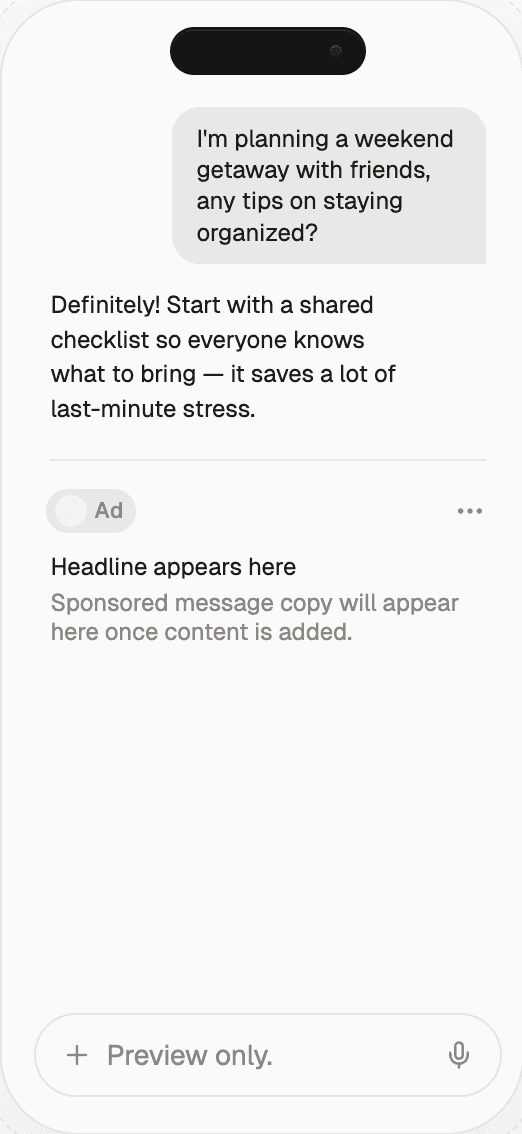
In April 2026, Google runs ads inside AI Overviews and AI Mode — bought through Performance Max, AI Max for Search, and broad-match- enabled Search campaigns — but the standalone Gemini app remains ad-free. Sponsored results appear in roughly 25.5% of AI Mode responses. No new Gemini-specific ads manager exists; the access point is the Google Ads account most performance marketers already operate. A cross-surface complement (ChatGPT Ads Manager, Microsoft Advertising, independent AI ad network) is necessary because Gemini alone does not cover the AI audience.


How to Advertise on Gemini in 2026 | Thrad
Gemini is not one surface — it's Google's AI Overviews, AI Mode, and the standalone Gemini app, and the ad product exists on two of the three. This walkthrough covers where ads actually show in Q2 2026, how to buy them through Performance Max and AI Max, which surfaces stay ad-free, and why an independent cross-surface program is the real completion of a Gemini media plan.
Date Published
Date Modified
Category
Advertising AI
Keyword
advertise on gemini

Start monetizing your AI app in under an hour
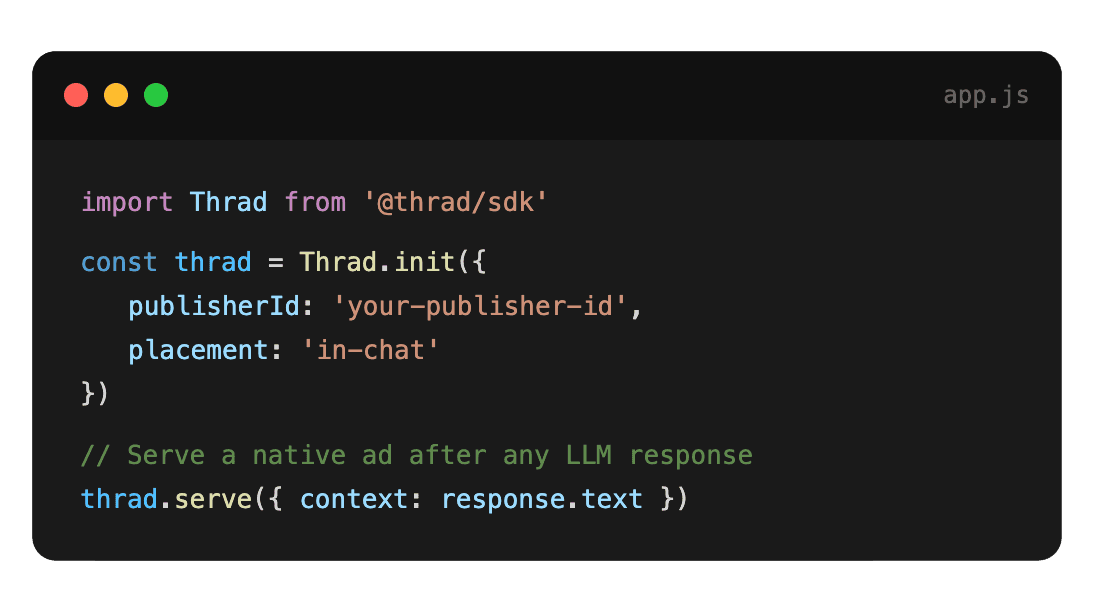
With Thrad, publishers go from first API call to live ads in less than 60 minutes. With fewer than 10 lines of code required, Thrad makes it easy to unlock revenue from your conversational traffic the same day.
Here is the short version most "advertise on Gemini" content won't give you: Gemini is not one product, ads live in two of its three surfaces, and the access point is the Google Ads account you already have — not a new Gemini-specific interface. This walkthrough covers where Gemini ads actually appear in Q2 2026, how to buy them, what the standalone app still refuses to carry, and how a cross-surface complement closes the gap that a Gemini-only plan leaves open.
What is Gemini advertising in 2026?
Gemini advertising in 2026 is ad placements inside Google's AI- generated search experiences — specifically AI Overviews (the AI answer block inside Google Search) and AI Mode (the dedicated AI Search experience). Ads are bought through Google Ads using Performance Max, AI Max for Search, or broad-match Search campaigns, placed automatically by Google's AI-driven matching, and labeled "Sponsored." The standalone Gemini app is not part of the paid-media inventory as of April 2026.
The practical implication is that brands are often "advertising on Gemini" without thinking of it that way — any Performance Max or broad-match Search campaign may already be showing up inside AI Overviews, because those are the eligible campaign types. The line between "Google Search ads" and "Gemini ads" is blurred by design.
In April 2026, roughly 25.5% of Google AI Mode responses surface a sponsored placement. Ads in AI Overviews and AI Mode are bought through the same Google Ads account performance marketers already operate — Performance Max, AI Max, and broad-match Search — not through a separate Gemini ads manager.
How do ads actually appear inside AI Overviews and AI Mode?
Ads in AI Overviews can appear above, below, or within the AI answer block on mobile and desktop. They are labeled "Sponsored" and are contextually integrated into the AI-generated experience rather than bolted on as separate display units. AI Mode surfaces ads inline with AI Mode responses — the exact layout varies, but the pattern is a sponsored placement visible alongside the AI answer.
Three structural things to know:
Ads are eligible, not guaranteed. Even when a brand is running
an eligible campaign, whether the ad appears depends on the query
matching, auction dynamics, and the AI response generating
commercial-intent context.Creative is sourced from existing campaigns. Performance Max
pulls from the asset group. AI Max for Search pulls from existing
Search campaign assets. There is no Gemini-specific creative
format required.Labeling is explicit. Every ad carries a "Sponsored" tag;
Google has been clear that distinguishing paid from organic is a
requirement, not a preference.
How do you buy Gemini ads?
Through Google Ads. The eligible campaign types for AI Overviews and AI Mode placements are:
Campaign type | How it appears in AI surfaces | Typical use case |
|---|---|---|
Performance Max | Ads placed automatically across Google's AI surfaces including AI Overviews | Cross-inventory retail, ecommerce, lead gen |
AI Max for Search | AI-forward upgrade of Dynamic Search Ads; ~7% lift in conversions at similar CPA | Brand performance campaigns wanting AI surface exposure |
Broad-match-enabled Search | Eligible for AI Overview placements | Classic keyword-based Search campaigns |
If you're already running one of these, your brand is likely already exposed to AI Overview / AI Mode placements — you just didn't label the line item that way internally. If you're not running one, AI Max for Search is the most AI-native campaign type to start with in Q2 2026, because Google's documentation explicitly positions it as the upgrade path for AI surfaces.
Step-by-step
Confirm your Google Ads account is active and you have
Performance Max, AI Max, or broad-match Search running.Check AI Overview / AI Mode placement eligibility — Google
enables this automatically for eligible campaigns; opt out is
possible but non-default.Review your asset group / creative assets. AI surfaces pull
from the same assets, so quality matters. Headlines, descriptions,
images, and videos that work for AI Overviews are the same assets
that work for other Google Ads placements.Set your targeting and budget. Standard Google Ads targeting
logic applies; there is no separate Gemini-specific targeting
layer.Monitor placement data. Google's reporting identifies AI
Overview placements; segment your reporting to see AI-surface
share of impressions and clicks separately from traditional SERP.Tune with AI Max. If you're not using AI Max for Search, the
documented lift (~7% more conversions at similar CPA/ROAS) is
worth the migration for brands that want AI-surface exposure.
Why isn't the standalone Gemini app carrying ads yet?
Three reasons, in decreasing order of importance:
Trust calibration. Google is watching OpenAI and Microsoft's
ad rollouts and calibrating the user-trust cost of ads in a
chatbot surface where users expect advice, not ads. Executives
have publicly emphasized that they have not ruled ads out but have
not shipped them either.Revenue model. Gemini has a standalone consumer subscription
tier (Google One / Gemini Advanced) that is the primary monetization
path today. Subscription and ads coexist but require different
product calibration.Competitive positioning. Not-shipping-ads is a differentiator
against ChatGPT, and Google has been watching whether users prefer
the ad-free Gemini app experience.
Conflicting public statements
Adweek reported in 2025 that Google briefed advertisers about a 2026 Gemini app rollout. Google's VP of Global Ads Dan Taylor publicly denied the plan in December 2025, and Demis Hassabis reiterated at Davos in January 2026 that there are no ads in the Gemini app. The honest read: Google has an option on standalone-app monetization and may ship in 2026, but has not publicly committed to a timeline.
What's the advertiser experience actually like?
The experience is not materially different from running Google Ads today, because AI Overview / AI Mode ads are served through the same interface. What changes:
Placement reporting expands — segmenting by AI Overviews / AI
Mode reveals how much of your spend is flowing to AI surfaces.AI Max migration — brands moving from DSAs to AI Max unlock
the documented ~7% conversion lift and match assets to AI-surface
context more reliably.Asset group quality matters more — AI surfaces render long-
form answers, so image and video quality, headline specificity,
and description relevance all drive placement eligibility.Brand safety runs through existing Google controls — no new
brand-safety setup is required specifically for AI Overviews.
For most performance marketers already running Google Ads, the switch from "Google Ads only" to "Google Ads + AI surfaces" is an optimization exercise, not a new platform onboarding.
How does Gemini compare to ChatGPT, Copilot, and independent AI networks?
One table that puts the Gemini opportunity in cross-surface context.
Surface | Ads live? | Ads manager | Typical pricing | Best fit |
|---|---|---|---|---|
Google AI Overviews / AI Mode | Yes | Google Ads (PMax, AI Max, Search) | Google Search auction | Brands already running Google Ads; retail, lead gen, ecommerce |
Standalone Gemini app | No (as of April 2026) | — | — | — |
ChatGPT | Yes | ChatGPT Ads Manager (self-serve, $50K min) | $60 CPM | Brand building in AI-native audience; ChatGPT Free/Go users |
Microsoft Copilot | Yes | Microsoft Advertising | Bing auction + Copilot Checkout commerce | Commerce-heavy; Shopify / Bing-integrated brands |
Claude | No — ad-free by policy | — | — | GEO + earned only |
Perplexity | No — discontinued Feb 2026 | — | — | GEO + earned only |
Independent AI ad network (e.g., Thrad) | Yes | Single integration, many AI surfaces | Varies by surface | Cross-surface reach, long-tail AI-native apps |
The useful observation: running a Gemini-only AI ad strategy covers Google's AI search users but misses ChatGPT's 800M weekly users, Copilot's commerce-heavy Microsoft audience, Claude's knowledge-work audience entirely, and the long tail of AI-native apps that the big four do not operate. A Gemini buy is a necessary but insufficient AI strategy in 2026.
What's a realistic cross-surface plan that starts with Gemini?
A sample 90-day plan for a brand that already runs Google Ads and wants to build from there.
Month 1 — Gemini-surface optimization. Ensure Performance Max and AI Max for Search campaigns are running. Segment AI Overview placement data. Upgrade creative assets so they perform in AI-surface contexts (specific headlines, schema, high- resolution imagery). Turn on AI Max for Search if not already.
Month 2 — cross-surface expansion. Stand up an ad program that covers advertising on ChatGPT if AI Overviews traffic is incremental and the commercial-intent audience overlaps your ICP. Stand up or expand Microsoft Advertising for Copilot reach, especially if you have a commerce angle. Open an independent AI ad network account (Thrad's AI ad platform or similar) for the long-tail AI-native surfaces the big platforms do not cover.
Month 3 — measurement and GEO. Build a Share of Model dashboard across Gemini, ChatGPT, Perplexity, and Claude. Launch or expand a GEO content program so organic citation rises across all four assistants. Run an incrementality test (geo-holdout or synthetic control) to validate the AI-surface spend.
The plan treats Gemini as the foundation rather than the whole program. Most Google-heavy performance teams get AI Overview placements "for free" because they're already in PMax / AI Max / broad-match Search — the job is recognizing that exposure and layering the other surfaces around it.
Common misconceptions about advertising on Gemini
"I need a separate Gemini ads manager." No. The Google Ads
account you already have covers Gemini AI Overviews and AI Mode
through eligible campaign types."Gemini ads are only in the Gemini app." The opposite —
Gemini-related ad inventory in 2026 is in Google Search (AI
Overviews) and AI Mode. The standalone app does not carry ads."If I run AI Max for Search, I have Gemini handled." AI Max
is necessary but not sufficient; Performance Max and broad-match
Search are also eligible placements, and creative quality across
your asset groups matters more in AI surfaces."Ads in AI Overviews hurt my brand trust." Google labels them
"Sponsored" and the user experience data so far shows engagement
rates comparable to or better than traditional Search placements."Gemini covers my AI audience." It covers Google's AI audience.
ChatGPT, Copilot, Claude, Perplexity, and the long tail of AI-
native apps are separate reach."I need to wait for Gemini app ads to ship before I plan for
Gemini." No — AI Overviews and AI Mode are the currently
addressable surfaces. Start there; add the standalone app if and
when it ships.
What changes through the rest of 2026?
Four things to watch:
Gemini app ads may ship. Google has given advertisers mixed
signals; if they do ship, the rollout timing and format will
materially change the Gemini map.AI Max rollout deepens. More campaign surfaces, more feature
completeness, more of the "PMax was the old default, AI Max is
the new default" pattern.Country expansion. AI Overviews ads are currently English-
only; non-English rollout expands the addressable inventory.Shopping integration inside Gemini chat. Etsy and Wayfair
purchase flows are being tested; a commerce layer inside Gemini
chat could create brand-placement adjacency even before display
ads ship.
How to get started — 30-day plan
Week 1 — audit. Confirm Performance Max, AI Max, and broad-
match Search are running. Segment AI Overviews / AI Mode
placement reporting. Identify which of your campaigns is already
getting AI-surface exposure.Week 2 — AI Max migration. If you're running Dynamic Search
Ads, upgrade to AI Max for Search. Review asset quality.Week 3 — cross-surface. Open ChatGPT Ads Manager, Microsoft
Advertising, and an independent AI ad network (Thrad) account.
Decide budget allocation across the four paid AI surfaces; Thrad's pricing page is where most mid-market teams model the cross-surface CPM comparison.Week 4 — GEO + measurement. Launch Share of Model monitoring
across Gemini, ChatGPT, Perplexity, Claude. Publish or upgrade
your top 5 GEO-optimized articles.
Gemini is one AI surface of five. The honest 2026 strategy treats it as the Google-adjacent foundation of a cross-surface program, not the whole program. Brands that build out from Gemini with a ChatGPT Ads Manager buy, a Microsoft Advertising layer, and an independent AI ad network (like Thrad) for the long tail will cover the audience that a Gemini-only plan leaves on the table.

google gemini ads, ai overviews ads, ai mode ads, performance max gemini, ai max for search, gemini app advertising
Citations:
Google Ads Help, "About ads and AI Overviews," 2026. https://support.google.com/google-ads/answer/16297775
Adweek, "Google Tells Advertisers It'll Bring Ads to Gemini in 2026," 2026. https://www.adweek.com/media/google-gemini-ads-2026/
PPC Land, "Google denies Gemini ads despite advertiser briefings on 2026 rollout," 2026. https://ppc.land/google-denies-gemini-ads-despite-advertiser-briefings-on-2026-rollout/
Sharp Innovations, "Ads in Google AI Overviews," 2026. https://www.sharpinnovations.com/blog/2026/02/ads-in-google-ai-overviews/
Google Blog, "Google's Dynamic Search Ads are upgrading to AI Max," 2026. https://blog.google/products/ads-commerce/dsa-upgrade-to-ai-max-2026/
ALM Corp, "Google Ads AI Max Recommendation: What to Know Before You Apply (2026)," 2026. https://almcorp.com/blog/google-ads-ai-max-recommendation-2026/
ALM Corp, "Google Ads Updates in 2026: Every Major Change, Timeline, and What Advertisers Need to Do Now," 2026. https://almcorp.com/blog/google-ads-updates-2026/
ExchangeWire, "Thrad Joins AgenticAdvertising.org as Founding Member," 2026. https://www.exchangewire.com/blog/2026/03/05/thrad-joins-agenticadvertising-org-as-founding-member/
Be present when decisions are made
Traditional media captures attention.
Conversational media captures intent.
With Thrad, your brand reaches users in their deepest moments of research, evaluation, and purchase consideration — when influence matters most.