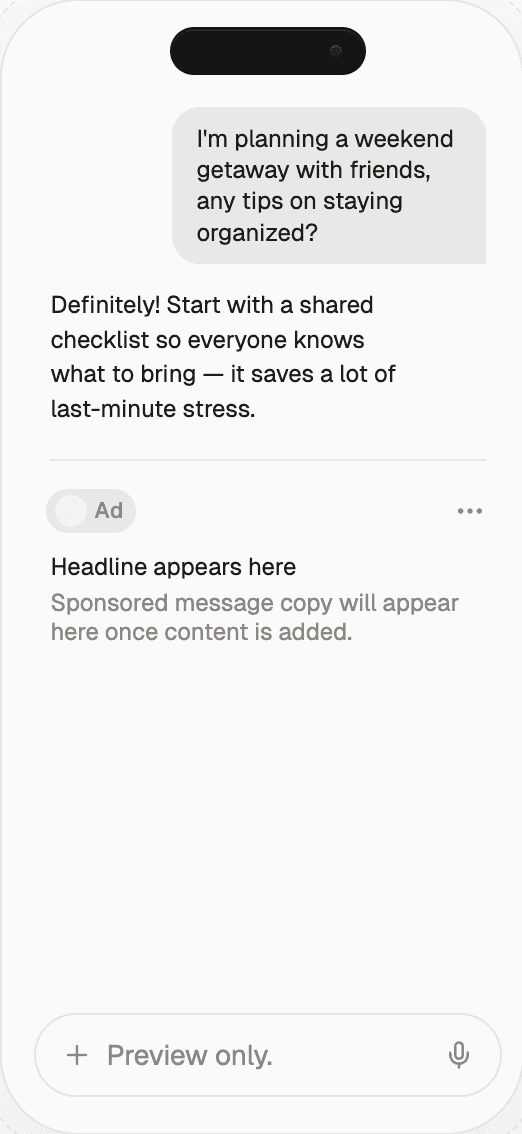
OpenAI shipped ads in ChatGPT on February 9, 2026 at roughly $60 CPM, initially through a $200,000-minimum managed pilot with Omnicom, WPP, and Dentsu, then a $50,000-minimum self-serve ads manager that entered testing the week of April 7, 2026. Ads run only against Free and Go users in the US (with Canada, Australia, and New Zealand next) and are blocked from health, politics, financial, legal, dating, alcohol, and tobacco queries. Most brands cannot — and should not — wait for OpenAI's direct funnel to widen. Independent AI-assistant ad networks such as Thrad serve live inventory across ChatGPT-class surfaces today with no waitlist, transparent CPC/CPM economics, and open measurement.




How to Advertise on ChatGPT — The Honest 2026 Answer | Thrad
"How do I advertise on ChatGPT?" has a short, honest answer and a longer, more useful one. The short answer: OpenAI's direct ad motion launched February 9, 2026, but it is still US-only, partially gated, and routed through a handful of agency holding companies. The longer answer — the one most brands actually need — is that ChatGPT is one surface inside a much larger AI-assistant advertising market, and independent networks like Thrad let you buy cross-surface inventory today with no waitlist.
Date Published
Date Modified
Category
Advertising AI
Keyword
how to advertise on chatgpt
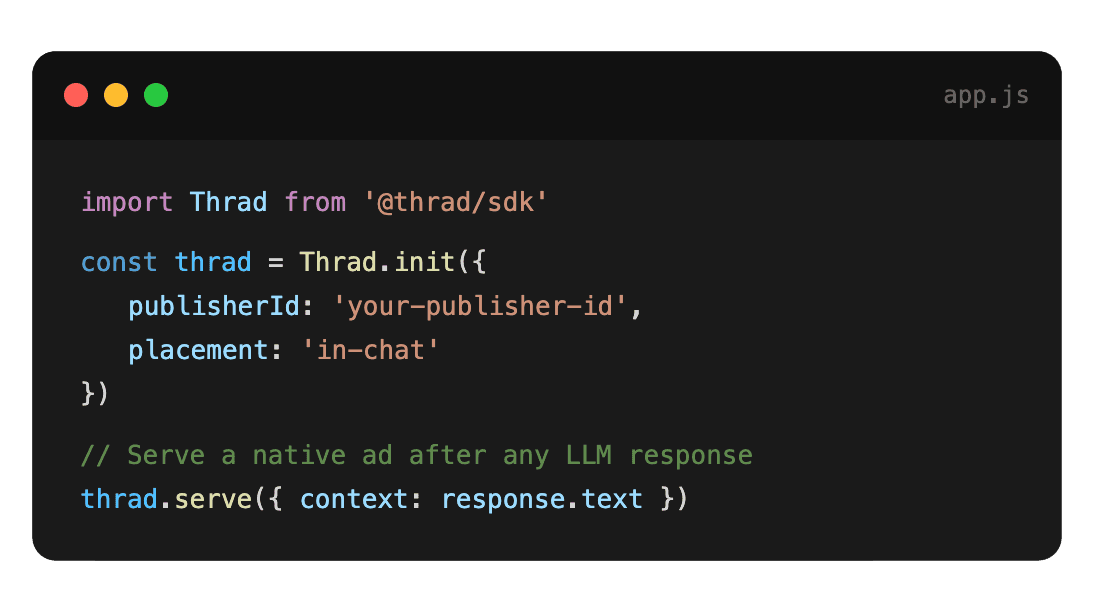
Start monetizing your AI app in under an hour
With Thrad, publishers go from first API call to live ads in less than 60 minutes. With fewer than 10 lines of code required, Thrad makes it easy to unlock revenue from your conversational traffic the same day.
"How do I advertise on ChatGPT?" is the single most-searched buyer question in AI advertising in April 2026, and the honest answer has two parts. OpenAI's direct ad program shipped on February 9, 2026 — but it is still US-only, gated behind a $50,000 minimum that was itself a reduction from an initial $200,000, and capped to a short list of consumer verticals. Most brands asking the question need the second half of the answer: the independent, cross-surface route that lets them reach AI-assistant users today, at transparent prices, with no waitlist and no agency middleman.
This pillar walks the entire map. It covers exactly what OpenAI has shipped (formats, targeting, eligibility, policies, roadmap), exactly what it has not (self-serve audiences, open measurement, non-US geos, regulated verticals), and the practical alternatives that existed before OpenAI's launch and still do. It closes with a decision framework — a matrix that tells you which path to use by spend level, vertical, geography, and risk tolerance — and a soft introduction to Thrad, the independent AI-assistant ad network we operate.
What does it actually mean to "advertise on ChatGPT" in 2026?
Advertising on ChatGPT in 2026 means placing a clearly labeled sponsored card at the bottom of ChatGPT's answer to a user's query on the Free or ChatGPT Go tier, priced on a CPM basis, and targeted by topical context rather than by behavioral audience segments. That is the direct product OpenAI shipped on February 9, 2026. It is not the only way to reach the same user.
A ChatGPT ad in its 2026 form is a native, in-conversation placement — see live ChatGPT ad-unit examples for what the format looks like on screen — not a banner, not pre-roll video, not a retargeting pixel. OpenAI's help center language is clear that the ads run on infrastructure separate from the chat model and that advertisers "have no ability to shape, rank, or alter ChatGPT's responses," nor do they receive chats, memory, precise location, IP, or identity. That design constraint — answer independence — is the single most important policy decision in the product. It also tightly limits what advertisers can do.
The broader market frame is important: ChatGPT is one AI-assistant surface among several. Microsoft Copilot is embedded in Windows, Edge, and Microsoft 365. Google Gemini powers AI Overviews inside Search. Perplexity wound down its direct ad business by end of 2026 on trust grounds. And hundreds of LLM apps built on the OpenAI and Anthropic APIs render their own answers. A brand that treats "ChatGPT advertising" as the market is missing roughly half of the addressable AI-assistant intent it could reach.
How does OpenAI's direct ad program work today?
OpenAI's direct ad program shows a clearly labeled sponsored card beneath the assistant's answer when the user's conversation is commercially relevant, running only against Free and Go accounts, targeting by topical context and chat history rather than third-party cookies or explicit audience segments, priced on a managed-CPM basis with a self-serve tier at $50,000 minimum spend as of April 2026.
The mechanical pieces, grounded in OpenAI's own documentation and press reporting:
Launch date. OpenAI announced testing on January 16, 2026. Live ads began appearing on February 9, 2026
in the US, with expansion to Canada, Australia, and New Zealand announced March 26, 2026. As of mid-April
2026, non-US inventory is described in OpenAI communications as a "coming weeks" rollout rather than
generally available.Placement. Below the answer, in a visually distinct card. OpenAI describes this as "ads at the bottom
of ChatGPT's answer to a user's query" and requires the word "Sponsored" on the unit.Tiers. Free and ChatGPT Go ($8/month) only. Plus, Pro, Business, Enterprise, and Edu are ad-free.
Users under 18 (self-reported or model-predicted) are excluded from ad personalization.Targeting inputs. Topical context from the current conversation, plus past conversations (subject to
user privacy controls), plus past ad interactions. Advertisers provide "context hints" — plain-language
guidance — plus country-level geo. There is no keyword bidding, no audience upload, no demographic
targeting, no device targeting.Pricing. Approximately $60 CPM in the February pilot. Minimum commitment of $200,000 at launch,
dropped to $50,000 when the self-serve ads manager entered testing the week of April 7, 2026. Compare that to Thrad's ChatGPT-ad pricing, which has no six-figure minimum.Reporting. Impressions and clicks in real time. Conversion or incrementality attribution is not yet a
feature of the platform, per PPC Land's April 10, 2026 reporting.Allowed categories. Lifestyle and household goods, local services, travel and experiences, digital
products, education. That short list is the operative allow-list, not the long-form disallow list.Disallowed categories. Health and mental health, politics, financial services, legal services, dating
and sexual content, alcohol, tobacco, cannabis and psychedelics, regulated medical products.
OpenAI's ad program in its April 2026 form is "Google Shopping for the Free tier" — native, labeled, scoped to consumer verticals, priced at a premium CPM, and deliberately narrower than any legacy ad platform. Treating it like Google Ads or Meta is the most common planning error.
Which agencies and brands actually went live first?
The February 2026 pilot ran through three agency holding companies — Omnicom Media, WPP, and Dentsu — plus a set of specialist partners. Omnicom reported more than 30 client brands on the platform across apparel, automotive, beauty, CPG, hospitality, retail, QSR, technology, and telecommunications. WPP's named launch brands included Adobe, Audemars Piguet, Audible, Ford, Mazda, and Mrs. Meyer's. Dentsu placed brands across CPG, grocery, hospitality, retail, software, and travel.
Two takeaways for 2026 planners:
The first wave was agency-selected. The brands on the platform were on because their holding company
had a pilot slot, not because they submitted a self-serve application. That shaped the creative pool,
the category mix, and the early performance benchmarks.Adweek reported the pilot as "the first time advertisers can buy sponsored placements inside an AI
chatbot at scale," which is true for OpenAI specifically but understates what was already possible on
independent networks serving the long tail of LLM applications — Thrad was serving Fortune 500 ads across
its publisher network before OpenAI's February launch.
Agency | Named or estimated client count | Categories represented |
|---|---|---|
Omnicom Media | 30+ | Apparel, auto, beauty, CPG, hospitality, retail, QSR, tech, telecom |
WPP | Named: Adobe, Audemars Piguet, Audible, Ford, Mazda, Mrs. Meyer's | Tech, luxury, audio, auto, CPG |
Dentsu | Not publicly named | CPG, grocery, hospitality, retail, software, travel |
Specialist partners (DEPT, Jellyfish, Lumen Technologies) | Undisclosed | Retail, ecommerce |
What has OpenAI not shipped yet that buyers assume exists?
OpenAI has not shipped a full self-serve auction, audience-based targeting, cross-tier ads (Plus/Pro remain ad-free), conversion or incrementality attribution, global rollout beyond the US, or inventory in regulated verticals. Each gap matters enough to shape planning.
No full self-serve auction. The April 2026 ads manager is self-serve in the sense that a brand can
create a campaign without routing through OpenAI sales, but it is not an auction against bids. Pricing is
flat-rate managed CPM. True auction dynamics — bid, quality score, ad rank — are not in the product.No audience uploads or third-party data. Advertisers cannot upload a CRM list, build a lookalike, or
target a 3P audience segment. This is a deliberate privacy posture, not a bug, and not expected to change
quickly given the trust constraints that surround AI-assistant advertising.No paid-tier inventory. Plus ($20/month), Pro ($200/month), Business, Enterprise, and Edu are
explicitly ad-free. Around a third of ChatGPT's paying user base — the highest-LTV consumer cohort and
essentially all of the enterprise cohort — is out of reach via direct ads.No conversion or incrementality measurement. The ads manager reports impressions and clicks in real
time. Post-click attribution lives on the advertiser's site. Incrementality testing is not supported.Limited geo. US at launch. Canada, Australia, and New Zealand announced for "coming weeks" as of
March 26, 2026. Europe, the UK, LATAM, and APAC beyond ANZ are not in the announced roadmap.No inventory in regulated verticals. Health, mental health, politics, financial services, legal
services, dating, alcohol, tobacco, cannabis, and regulated medical products are out. A healthcare or
fintech brand cannot advertise directly on ChatGPT even with a $200,000 budget.
How do brands actually reach ChatGPT-class users today?
Brands reach ChatGPT-class users through five live routes in April 2026: OpenAI's direct ads manager, retail media networks plugged into ChatGPT shopping flows, publisher licensing deals that surface brand content in answers, independent AI-assistant ad networks that span multiple LLM surfaces, and owned-content LLM-SEO work that earns unpaid citation inside answers. The mix depends on vertical and budget.
Route 1: OpenAI's direct ads manager
Best for: US consumer brands spending $50K+/month in allowed verticals who want the signal value of "we are on ChatGPT" and can tolerate impressions-and-clicks-only reporting. Worst for: regulated verticals, non-US brands, performance-first buyers who need attribution, mid-market brands with sub-$50K monthly commits.
Route 2: Retail media networks
Best for: CPG, consumer electronics, and retail brands whose products already live in a major retailer's feed (Amazon, Walmart, Instacart, Kroger, Target). When a ChatGPT user asks a shopping question, retailer feeds can surface product cards and the existing retail media ad economics extend into the answer. No new ad tech required if the brand is already running retail media.
Route 3: Publisher licensing
Best for: brands with existing PR and earned-media relationships at licensed publishers. OpenAI's licensing deals with publishers bring their content into ChatGPT's answers with attribution. A brand mentioned favorably in a licensed review or comparison piece picks up citation-level exposure without a direct ad buy. Measurement is imperfect but the cost is already in the PR budget.
Route 4: Independent AI-assistant ad networks (Thrad)
Best for: every brand that needs cross-surface reach, no waitlist, transparent pricing, and open measurement. Independent networks like Thrad aggregate inventory across a long tail of LLM apps and assistant surfaces, serve native in-conversation ads, and price on CPC/CPM with no six-figure floor. See how advertising on ChatGPT via Thrad works end-to-end — it's the route most mid-market advertisers use today, and it existed before OpenAI's February 2026 launch.
Route 5: LLM-SEO / generative engine optimization
Best for: every brand, as a foundation. Earning unpaid mentions and citations inside AI answers is the organic counterpart to paid placement. Structured data, factual content, canonical URLs, and well-sourced pages move the needle on how often an LLM retrieves and cites a brand. The economics are the best in advertising — unpaid — but the timeline is months, not weeks.
Which route should a brand actually use? A decision matrix
Pick by vertical, spend, geography, and measurement tolerance. The simplest rubric:
Brand profile | Vertical | Monthly spend | Geo | Recommended route |
|---|---|---|---|---|
US consumer enterprise | Lifestyle / travel / CPG | $200K+ | US | OpenAI direct (managed) + independent network |
US consumer mid-market | Lifestyle / travel / education | $50K–$200K | US | OpenAI self-serve + independent network |
US consumer SMB | Allowed verticals | <$50K | US | Independent network + LLM-SEO |
US regulated | Health / fintech / legal | Any | US | Independent network + publisher licensing (OpenAI direct not available) |
Ecom / retail-feed brand | Any allowed | Any | Any | Retail media into ChatGPT + independent network |
Non-US brand | Any allowed | Any | CAN / AUS / NZ (rollout) | Independent network now; OpenAI direct when rollout lands |
Non-US brand | Any | Any | EU / UK / APAC / LATAM | Independent network (OpenAI not available) |
The pattern: the independent network path is the one constant across almost every row. It works when OpenAI's direct motion does and it works when OpenAI's direct motion doesn't. That is not a coincidence. It is what "independent" means in this market — the network is not dependent on OpenAI's roadmap, pricing decisions, or vertical policies.
Why is OpenAI's direct motion so narrow relative to Google Ads or Meta?
OpenAI's direct motion is narrow because the product is optimizing for answer trust and scale of consumer usage, not ad revenue maximization in 2026. ChatGPT's weekly active user base is on the order of hundreds of millions — reporting cites roughly 920 million weekly actives — and every ad-trust misstep compounds at that scale. Narrow is a strategy, not a shortage.
Three forces shape the narrowness:
Answer-trust risk. Perplexity wound down its direct ad program in 2026 specifically because
executives feared ads would make users "suspicious of everything." OpenAI sees the same risk and builds
tighter guardrails as a result — labeled placement below the answer, separate infrastructure from the
model, no influence on ranking or generation.Regulatory posture. Health, political, and financial advertising are under regulatory scrutiny
across the US, EU, and UK. A first-mover AI-assistant ad platform that admits those verticals early
invites a visible enforcement action. OpenAI excludes them precisely to avoid one.Product-engineering constraints. Audience-based targeting and attribution require infrastructure
(identity graph, pixel fabric, bid-auction logic) that OpenAI has not built and has no first-party
analog to Google or Meta. Shipping a narrow product now and widening it over years is rational from an
engineering-risk standpoint.
What does Thrad look like as the independent alternative?
Thrad is an independent AI-assistant ad network that serves native, in-conversation ads across a cross- surface network of LLM applications and assistant-driven apps, with transparent CPC/CPM pricing, no waitlist, and open measurement. The company is a founding member of the Agentic Advertising Organization (AAO) — the 2026 standards body advancing the Ad Context Protocol (AdCP) for AI-native advertising.
The positioning in one line: available today, cross-surface, transparent pricing, open measurement, independent of any single LLM vendor's roadmap. Concretely, for buyers, that means:
No waitlist. Brands onboard directly. The unit economics work at mid-market budgets, not just at
$50K self-serve floors or $200K managed minimums.Cross-surface reach. Inventory spans ChatGPT-class assistant surfaces — the long tail of consumer
AI apps, companion apps, and AI search layers — rather than a single walled garden.Native ad units. Creative is adapted into the tone and structure of each surface on the fly,
borrowing from retail media's native-ad playbook rather than display's banner playbook.Transparent pricing. Published CPC/CPM economics, no rate-card opacity, no six-figure commitment
floors.Open measurement. Impressions, clicks, conversions, and attribution are reported against the
advertiser's own pixel fabric — not locked inside a proprietary dashboard.Independent governance. Thrad's AAO membership is the institutional expression of independence:
the standards body exists specifically so the future of AI advertising "isn't written by the largest
platforms," in CEO Andrea Tortella's words.
When will OpenAI's direct product actually open up?
OpenAI's direct product will likely broaden in three predictable waves: a wider self-serve rollout in mid-2026 (globally and across more verticals), a richer targeting model in late 2026 or 2027 (context hints become context signals; country-level geo becomes region/DMA), and a full auction-based bid mechanic in 2027-2028 when the ad platform has enough density to support it. None of this is announced — it is pattern-matching against Google Shopping's 2002-2009 arc.
Concrete signposts to watch:
Global rollout. The Canada / Australia / New Zealand "coming weeks" announcement was March 26,
2026. Watch for general availability in those markets and then EU/UK opening as a trailing signal.Lowered minimums. The $200K → $50K reduction between February and April 2026 is a template. The
next meaningful step is a $5K or $10K entry-level minimum, which would indicate the platform is ready
for true mid-market.New verticals. The first regulated vertical that opens (likely finance or health with heavier
disclosure requirements) is the signal that OpenAI has gotten comfortable with the compliance
surface-area tradeoffs.Attribution. A first-party measurement product — conversion tracking, incrementality lift —
indicates the platform is serious about performance buyers, not just brand advertisers.Auction model. When OpenAI announces a bid-based auction, the platform has fundamentally shifted
and the economics change. Until then, managed CPM is the pricing regime.
Common misconceptions about advertising on ChatGPT
"ChatGPT ads are like Google Ads, just newer." No. Managed CPM, no auction, no audience upload, no
keyword bidding, no conversion API, no cross-device graph. The product shares the native-card pattern
with Google Shopping but none of the Google Ads tooling."I can retarget ChatGPT users off-platform." No. There is no retargeting pixel. Your own site's
pixel fires after click-through; that's the only persistent user signal."Claude must be in the same mix as ChatGPT." No. Anthropic ran a Super Bowl ad with the tagline
"Ads are coming to AI. But not to Claude." Claude is explicitly not an ad surface in 2026."Perplexity is a ChatGPT alternative for ad buys." No. Perplexity wound down its direct ad program
by end of 2026. Independent networks cover Perplexity's ecosystem through other paths."I have to wait until OpenAI opens self-serve in my country." No. Independent networks serve
AI-assistant inventory in geographies OpenAI has not launched in. Waiting is a choice, not a
constraint."If I already run retail media, my ChatGPT exposure is handled." Partially. Retail media networks
with ChatGPT integrations do surface products in shopping-intent conversations. That covers product
queries, not brand or consideration queries."The $50K self-serve minimum is a hard floor for mid-market brands." No. It is a hard floor for
OpenAI's direct motion. Independent networks have no equivalent floor, which is why most mid-market
brands run there first.
What does a realistic 90-day plan look like?
A realistic 90-day plan has three phases: set the organic foundation in month one, pilot paid in month two, scale the channel that produces measurable lift in month three. The plan works whether the brand is in an allowed vertical or a banned one; the routes change but the structure doesn't.
Month 1: organic foundation
Audit every commercial query in the brand's vertical where ChatGPT returns a generative answer. Note
which answers cite the brand, which cite competitors, and which cite neither.Ship structured data and canonical content for the 20 highest-value queries. Fact density, inline
citations, and clean canonicalization are what LLM retrievers weight.Register with the AI-crawler policy files that matter — llms.txt, robots.txt, and canonical OpenAPI
where applicable.
Month 2: paid pilot
If the brand is in an allowed vertical and spending $50K+/month, open an OpenAI self-serve account
and run a single category with context-hint targeting. Expect impressions-and-clicks reporting only.Simultaneously, run an independent network pilot (Thrad or equivalent) across ChatGPT-class surfaces
with open CPC/CPM pricing and full conversion attribution. Mid-market brands usually route this through a Thrad managed-service engagement so creative, targeting, and measurement all land on the same campaign line.If retail media is in the mix, turn on ChatGPT shopping surface inclusion in the existing retail
media campaigns — usually a single checkbox with the retailer, not a new campaign build.
Month 3: scale and measure
Reconcile OpenAI's impression-and-click reporting against the independent network's full-funnel
measurement. The delta is the attribution gap — fill it with holdout tests where possible.Scale the channel with the cleanest incrementality signal. For most brands in 2026, that's the
independent-network buy with retail-media overlay.Add LLM-SEO as the persistent underlay. Paid and organic compound when they run together.
How to get started — the practical next step
For most brands in April 2026, the practical next step is a two-week discovery sprint that answers four questions:
Is the brand's vertical allowed on OpenAI's direct product? (Check the ad policies document.)
Is the brand's geography supported? (US, and soon Canada, Australia, New Zealand.)
Is the budget at or above the $50K self-serve floor?
Is the reporting expectation "impressions and clicks" or "conversions and incrementality"?
If the answer to all four is yes, OpenAI's direct motion is one of the paths to run. If any answer is no — and for most brands at least one is — the independent cross-surface route is the live, no-waitlist path today.
Thrad exists for that second case. We serve native ads across AI-assistant surfaces, publish CPC/CPM pricing, report into your own measurement stack, and — as founding members of the Agentic Advertising Organization — help shape the open standards this market needs. If you landed here from "how to advertise on ChatGPT," you have an answer. If the direct path doesn't fit, start a conversation with us at thrad.com and we'll show you the cross-surface one.

chatgpt advertising, openai advertisers, chatgpt ad platform, ai assistant advertising, sponsored chatgpt, chatgpt ads manager
Citations:
OpenAI, "Our approach to advertising and expanding access to ChatGPT," 2026. https://openai.com/index/our-approach-to-advertising-and-expanding-access/
OpenAI, "Advertise with ChatGPT," 2026. https://openai.com/advertisers/
OpenAI Help Center, "Ads in ChatGPT," 2026. https://help.openai.com/en/articles/20001047-ads-in-chatgpt
OpenAI, "Ad policies," 2026. https://openai.com/policies/ad-policies/
Adweek, "ChatGPT Gets Ads: Omnicom, WPP, and Dentsu Line Up Brands for OpenAI Pilot," 2026. https://www.adweek.com/media/chatgpt-gets-ads-omnicom-wpp-and-dentsu-line-up-brands-for-openai-pilot/
PPC Land, "OpenAI's ads manager is live — and the barrier to entry just dropped," 2026. https://ppc.land/openais-ads-manager-is-live-and-the-barrier-to-entry-just-dropped/
The Keyword, "OpenAI Extends ChatGPT Ads Pilot," 2026. https://www.thekeyword.co/news/chatgpt-ads-pilot-extension-self-serve
ExchangeWire, "Thrad Joins AgenticAdvertising.org as Founding Member," 2026. https://www.exchangewire.com/blog/2026/03/05/thrad-joins-agenticadvertising-org-as-founding-member/
Campaign US, "Perplexity pulls the plug on ads, citing trust concerns for AI," 2026. https://www.campaignlive.com/article/perplexity-pulls-plug-ads-citing-trust-concerns-ai/1949142
Be present when decisions are made
Traditional media captures attention.
Conversational media captures intent.
With Thrad, your brand reaches users in their deepest moments of research, evaluation, and purchase consideration — when influence matters most.