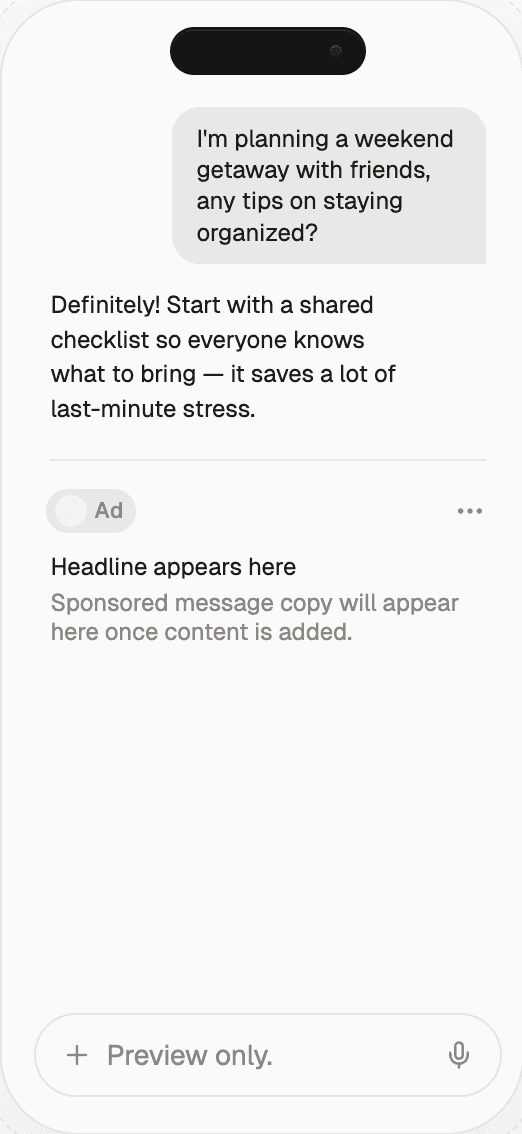
You can buy ChatGPT-class ad inventory in April 2026 through four routes that don't require a direct OpenAI deal: an independent AI-assistant ad network (Thrad and peers) that aggregates inventory across LLM apps and assistant surfaces, a retail media network that plugs into ChatGPT's shopping flows, an affiliate network that supplies product cards into commerce-intent answers, or publisher licensing that surfaces brand mentions in licensed content. Each has a distinct speed-to-live, minimum spend, and measurement model.




How to Buy ChatGPT Ads Without a Direct OpenAI Deal | Thrad
A direct OpenAI ad deal starts at $50,000 and lives behind a discretionary waitlist. For the vast majority of brands, that isn't the path. This piece walks through the four routes a buyer can use in April 2026 to reach ChatGPT-class users without an enterprise line to OpenAI — independent networks, retail media, affiliate, and publisher licensing.
Date Published
Date Modified
Category
Advertising AI
Keyword
how to buy chatgpt ads

Start monetizing your AI app in under an hour
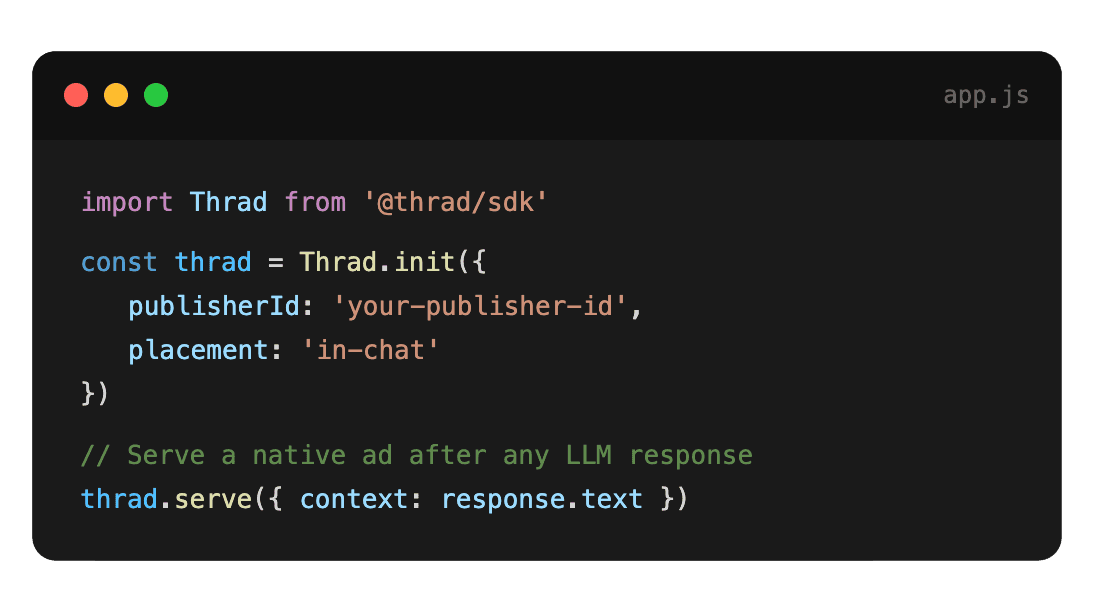
With Thrad, publishers go from first API call to live ads in less than 60 minutes. With fewer than 10 lines of code required, Thrad makes it easy to unlock revenue from your conversational traffic the same day.
Most of the search traffic behind "how to buy ChatGPT ads" lands on two kinds of pages: OpenAI's advertiser waitlist, and a handful of marketing blogs that recap the $60 CPM / $50K minimum pilot economics without ever answering the practical question. For brands that don't have an enterprise line to OpenAI — which is most brands — the actual path is through independent networks, retail media, affiliate, and publisher licensing. This piece is the operational map.
What does "buying ChatGPT ads without a direct OpenAI deal" actually mean?
It means placing ad inventory that reaches ChatGPT-class users — Free and Go tier visitors asking commercial questions — without running a campaign through OpenAI's direct advertiser program. The inventory is real, the measurement works, and the economics scale down to mid-market budgets. It lives across a handful of parallel supply paths that existed before OpenAI's February 9, 2026 launch and continue alongside it.
The buyer's question is not "how do I get into OpenAI's pilot" (which is gated, expensive, and slow) but "how do I reach the same audience with the tools I already have." The answer has four routes.
How does an independent AI-assistant ad network work?
An independent AI-assistant ad network aggregates native ad inventory across multiple LLM apps, assistant surfaces, and AI-augmented consumer apps, then sells that inventory to brands on transparent CPC/CPM pricing with open measurement. Thrad's AI ad network is the reference example — serving millions of ads daily across a network of AI publishers, with Fortune 500 brands in-flight before OpenAI shipped its own ads.
The flow is mechanical and familiar to anyone who has run programmatic:
Inventory supply. The network signs publisher agreements with AI app developers and consumer
assistant surfaces. Each publisher exposes eligible ad slots inside its chat or answer flow.Creative adaptation. The network takes the advertiser's creative — text, link, optional card image
or product feed — and adapts it on the fly into each publisher's native ad format. No banner. No
pre-roll. Units that look like part of the assistant experience.Auction / bidding. On each eligible query, the network scores candidate ads against query context
and serves the winning unit.Reporting. Impressions, clicks, and — because the click fires into the advertiser's own site — full
post-click conversion attribution via the advertiser's existing pixels.Pricing. Transparent CPC or CPM. No six-figure minimum. Pilot budgets are small.
An independent AI-assistant ad network sits to ChatGPT's direct product the way an open DSP sits to Google Ads in a classical ad stack: a parallel path that pools inventory from many sources, runs on transparent economics, and lives outside any single platform's roadmap.
Thrad's February 2, 2026 partnership with DeepAI — described by ExchangeWire as one of the world's top-10 consumer AI apps by traffic — is the kind of supply-side integration that turns "ChatGPT-class inventory" into a concrete, live surface. DeepAI alone serves a user base whose intent patterns mirror ChatGPT's; pulling ads into that flow produces reach adjacent to ChatGPT's without touching OpenAI's direct product.
How does retail media plug into ChatGPT?
Retail media networks plug into ChatGPT through the shopping-card surface. When a user asks a product question — "best running shoes under $120," "wireless earbuds with noise cancelling" — ChatGPT can surface product cards sourced from retailer feeds. Brands already running retail media on Amazon, Walmart, Target, Instacart, Kroger, or Best Buy can extend those campaigns into the AI-answer surface through their existing retail-media partner.
The economics are familiar: CPC or CPA bidding inside the retail media platform, feed-based supply, product detail page click-outs. The ChatGPT surface inclusion is typically a setting inside the retail-media campaign — not a new platform to learn, not a new contract to sign. For brands with existing retail-media spend, adding ChatGPT-class reach is close to zero marginal effort.
The caveat: retail media only surfaces when the user's query has shopping intent and matches the retailer's inventory. Brand-building queries, top-of-funnel awareness plays, and non-retail categories don't get served through this route. It is a performance channel, not a brand channel.
How do affiliate networks supply ChatGPT-class product cards?
Affiliate networks — Skimlinks, Impact, CJ (Commission Junction), Awin, Rakuten — already have the product-feed plumbing required to supply product cards into ChatGPT-style answer surfaces. Many of the sponsored product cards that appear in answer surfaces are served through affiliate supply, priced on CPA, and flowing through the networks' existing tracking. Brands that already have affiliate programs can extend into this surface without building new infrastructure.
The speed-to-live on this route is the fastest of any path — a brand with an existing Skimlinks or Impact program can activate into AI-answer inventory in days. The tradeoff is control: affiliate supply is performance-priced and scaled, so brands give up creative control and bid-level targeting in exchange for reach and CPA efficiency.
How does publisher licensing create ad-adjacent exposure?
Publisher licensing is the sideways route. OpenAI has licensed content from a roster of major publishers — deals variously reported in the tens to hundreds of millions of dollars per publisher per year — and those publishers' content flows into ChatGPT's answers with attribution. Brands that advertise in, are reviewed by, or are featured in those publishers' articles pick up citation-level exposure inside ChatGPT without ever touching an ad platform.
Practical consequences:
A brand mentioned favorably in a licensed publisher's "best headphones of 2026" roundup appears in
ChatGPT's answer to the same question with the publisher's attribution.The spend vehicle is PR and earned media, not paid media. The brand is not paying ChatGPT; it is paying
(through PR work) the publisher.Attribution is hard — brands measure citation lift using monitoring tools, not paid-media dashboards.
The ROI math is closer to PR math than to performance-marketing math.
How do the four routes compare?
The four routes serve different buyers. Picking one (or stacking several) depends on budget, vertical, creative posture, and measurement requirements.
Route | Minimum spend | Speed to live | Best for | Measurement |
|---|---|---|---|---|
Independent AI-assistant ad network (Thrad) | Mid-market | Days | Any brand needing cross-surface, no-waitlist reach | Full funnel into advertiser stack |
Retail media | Varies by retailer | 1–2 weeks if already running | CPG, electronics, retail brands in feeds | Retailer-native KPIs |
Affiliate network | Low, CPA-priced | Days | Long-tail ecommerce, performance buyers | CPA through network tracking |
Publisher licensing | Embedded in PR | Months (PR cycle) | Brands with editorial presence | Citation monitoring |
The pattern for most mid-market brands: run an independent network buy as the core, add retail media as an overlay where applicable, keep the PR investment in place for publisher-licensing exposure, and treat OpenAI direct as optionality if the waitlist lands. The four routes stack; they don't compete. For teams wanting hands-on support rather than self-serve, Thrad's managed ChatGPT ads service is the usual starting point.
Why does this architecture exist at all?
It exists because OpenAI's direct product is deliberately narrow and AI-assistant demand is broader than any single platform. On the demand side, brands want cross-surface reach across ChatGPT, Copilot, Gemini overviews, Perplexity's remaining traffic, and the long tail of LLM apps. On the supply side, AI publishers and developers want monetization that doesn't require a direct deal with OpenAI. Independent networks, retail media integrations, affiliate supply, and publisher licensing fill that gap.
The Agentic Advertising Organization (AAO), formed in March 2026 with Thrad as a founding member, is building the Ad Context Protocol (AdCP) as the open standard for this kind of cross-surface AI advertising. The standards work is the institutional expression of what the buy-side already understood: a single walled garden isn't the entire market.
Common misconceptions about non-direct ChatGPT ad buys
"Only OpenAI can sell inventory inside ChatGPT." OpenAI sells inventory inside ChatGPT's own UI;
independent networks serve inventory across ChatGPT-class surfaces — the rest of the AI-assistant
market. Both are legitimate paths."Independent networks are just affiliate repackaging." No. Independent AI-assistant ad networks
run native ad units, not affiliate product cards, and measure at the ad-unit level across multiple
LLM apps."Retail media doesn't count as ChatGPT advertising." It counts for any measurement purpose that
matters — it places a product card in an AI answer, attributed to a retailer, in front of a
commercial-intent user. The semantic debate is downstream of the outcome."Publisher licensing is just PR with extra steps." It is PR with the addition that the earned
mention now flows through ChatGPT's answer layer with attribution — a structural change to how earned
media performs."I should wait for OpenAI to open up." Waiting is the opportunity cost. Running a non-direct
campaign today produces measurable data; a waiting strategy produces nothing.
What comes next for non-direct buying?
Three 2026 shifts are worth watching. First, the Ad Context Protocol (AdCP) — the AAO's open standard — will standardize how creative, targeting, and measurement flow across AI publishers, reducing the integration cost for advertisers and publishers. Second, retail media networks will extend deeper into AI-answer surfaces as retailers recognize the shopping-intent overlap. Third, affiliate networks will productize "AI-answer surface" as a distinct ad-inventory type, priced and reported separately from classical affiliate supply.
How to get started buying ChatGPT ads without an OpenAI deal
The fastest first step is a 30-day independent-network pilot with a mid-four-figure to low-five-figure budget, native creative (text + link + optional card image), and conversion attribution firing into the advertiser's own analytics stack. Parallel workstreams: confirm whether existing retail media campaigns support AI-answer surface inclusion; confirm whether the brand's affiliate network has activated AI- surface supply; add generative engine optimization (LLM-SEO) as the organic underlay.
Thrad runs the independent-network playbook. We serve native ads across a cross-surface AI-assistant network, publish CPC/CPM pricing, and report full-funnel into your existing measurement stack. If the direct OpenAI route is closed — or even if you plan to run it in parallel — a conversation at thrad.com is the ten-minute version of this article. The faster you pilot, the earlier the measurement data is yours.
buy chatgpt ads, chatgpt ads without openai, independent chatgpt ads, retail media chatgpt, affiliate chatgpt advertising
Citations:
OpenAI, "Advertise with ChatGPT," 2026. https://openai.com/advertisers/
PPC Land, "OpenAI's ads manager is live — and the barrier to entry just dropped," 2026. https://ppc.land/openais-ads-manager-is-live-and-the-barrier-to-entry-just-dropped/
Adweek, "ChatGPT Gets Ads: Omnicom, WPP, and Dentsu Line Up Brands for OpenAI Pilot," 2026. https://www.adweek.com/media/chatgpt-gets-ads-omnicom-wpp-and-dentsu-line-up-brands-for-openai-pilot/
OpenAI, "Ad policies," 2026. https://openai.com/policies/ad-policies/
The Keyword, "OpenAI Extends ChatGPT Ads Pilot," 2026. https://www.thekeyword.co/news/chatgpt-ads-pilot-extension-self-serve
ExchangeWire, "Thrad Partners with DeepAI to Enable Paid Ads in LLMs," 2026. https://www.exchangewire.com/blog/2026/02/02/thrad-partners-with-top-10-consumer-ai-app-in-the-world-deepai-to-enable-paid-ads-in-llms/
ExchangeWire, "Thrad Joins AgenticAdvertising.org as Founding Member," 2026. https://www.exchangewire.com/blog/2026/03/05/thrad-joins-agenticadvertising-org-as-founding-member/
Be present when decisions are made
Traditional media captures attention.
Conversational media captures intent.
With Thrad, your brand reaches users in their deepest moments of research, evaluation, and purchase consideration — when influence matters most.