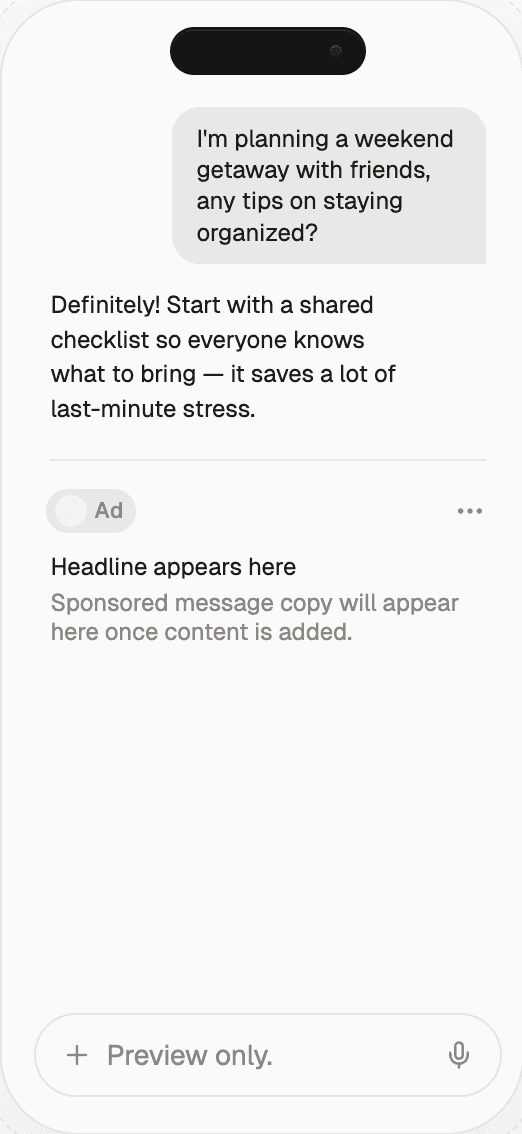
Intent-based targeting inside AI assistants scores ad eligibility against the user's live prompt (and often the preceding conversation) rather than against keywords or cookie-based audiences. It is the defining advantage of AI-assistant inventory — Verve Group said openly in 2026 that it operationalized "high-fidelity intent data from AI chat interfaces" as the industry-first version of this lever. As of April 2026, OpenAI's ChatGPT direct product exposes coarse commercial-category targeting only; Thrad and other independents expose prompt-level intent scoring, intent-tier segmentation (research / compare / buy), and cross-surface intent portability — the levers a 2026 performance buyer actually needs.






Intent-Based Targeting in AI Assistants 2026 | Thrad
The single biggest upgrade AI-assistant advertising offers vs search and display is intent. A user typing "best enterprise password manager for SOC 2" into an assistant has already classified themselves for you. This piece walks the 2026 reality of intent-based targeting inside AI assistants — what the signal is, how it's extracted, what OpenAI currently exposes, and why independent networks win on this lever.
Date Published
Date Modified
Category
Advertising AI
Keyword
chatgpt intent targeting

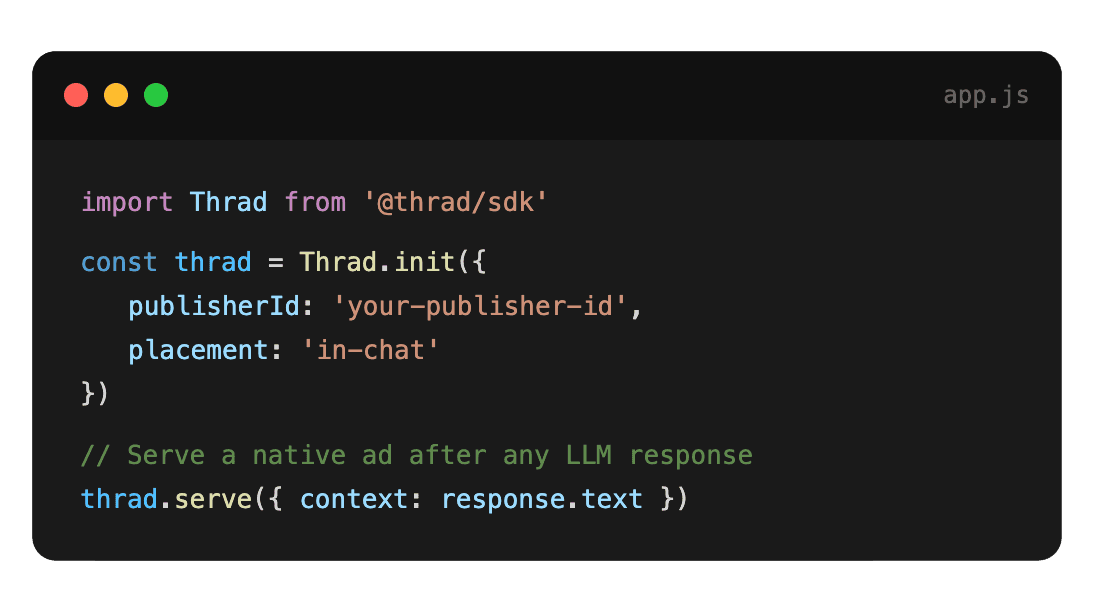
Start monetizing your AI app in under an hour
With Thrad, publishers go from first API call to live ads in less than 60 minutes. With fewer than 10 lines of code required, Thrad makes it easy to unlock revenue from your conversational traffic the same day.
Intent is the single biggest reason advertisers should care about AI-assistant inventory, and it is the lever most likely to stay undersold through 2026. A user who prompts ChatGPT with "best enterprise password manager with SOC 2 and SSO under $8 per seat" has declared their category, budget, compliance requirements, and buying stage in one sentence. A Google searcher would have issued three queries to surface the same signal; a display audience would have required weeks of behavioral inference. AI-assistant targeting collapses that chain to zero. This guide walks the 2026 reality — how the intent signal is produced, what OpenAI exposes, and why independent networks running ChatGPT-class ads already win on this lever.
What is intent-based targeting inside AI assistants?
Intent-based targeting inside AI assistants is ad-matching that scores eligibility against the user's live prompt (and, on richer implementations, the preceding conversation turns) rather than against keywords, audience segments, or cookie pools. It is the native targeting mode of the AI-assistant surface — the analogue of keyword targeting on search or behavioral audiences on display, but richer on every axis because the input is typed intent, not inferred intent.
The signal has three parts. First, a topic classification — what commercial or informational category the prompt falls into. Second, an intent strength score — how close the user is to a purchase decision. Third, an intent tier — "researching," "comparing," "ready to buy," or a category-specific variant. Advertisers bid against combinations of those three dimensions. Industry data from Verve Group's 2026 launch confirms the signal is production-scale: Verve reported processing "over 1 billion daily signals" from LLM environments as of its March 2026 announcement.
How is the intent signal derived from prompts?
The signal is derived in three stages. Stage one is a classifier that reads the prompt and preceding turns, identifies the topic, and outputs a commercial-intent score. Stage two is a category mapping that reconciles the prompt's topic to the advertiser-facing taxonomy (think: "ergonomic chair comparison" to "office furniture" to "consumer home goods"). Stage three is eligibility — an ad runs only if its targeting matches the topic, category, and intent tier, and it sits inside a non-sensitive context.
The classifier itself is usually an LLM or a smaller, fine-tuned intent model layered on top of the assistant's own context. The advertiser never sees the raw prompt. Launchcodex's 2026 analysis summarizes OpenAI's approach plainly: "Ads are selected based on relevance signals, but advertisers do not receive your chat content." Independent networks follow a similar pattern — aggregated, pseudonymized signal surfaces to the buyer; raw conversation content does not.
The information content per impression on an AI-assistant placement is materially higher than on search or display — the user has already classified themselves by category, budget, and buying stage in a single natural-language prompt. This is why intent-based targeting is the defining feature of the surface, not a bonus lever.
Why does intent-based targeting matter more in 2026?
It matters more in 2026 because the industry is rebuilding on first-party and declared-intent signals after a five-year run of cookie-deprecation and privacy-reg pressure. The 2026 state-of-play data is clear: 84% of B2B marketing leaders say they'll rely on first-party and intent-based signals for their programmatic strategy by year-end, according to the 2026 programmatic trend research compiled by Specificity and peer firms. Audience targeting built on third-party cookies keeps degrading; targeting built on live prompt intent keeps improving because the underlying signal volume compounds as AI-assistant usage grows.
There's a second 2026 reason: attribution. Classical attribution assumes a behavior trail; AI-assistant sessions collapse that trail into one prompt. If you can target on intent with high precision, you no longer need to compensate for messy attribution with broad targeting — you tighten targeting so tightly that incrementality measurement (covered in our measurement piece) carries the rest.
What intent-based targeting does OpenAI expose today?
OpenAI's direct product exposes coarse, category-level targeting as of April 2026, not prompt-level intent. On the April 13, 2026 self-serve manager pilot, advertisers pick commercial categories that roughly mirror the allow-listed verticals in OpenAI's ad policy — lifestyle and household goods, local services, travel and experiences, digital products, education. There is no exposed prompt-level intent-tier control, no ability to bid differently on research-phase prompts vs buy-phase prompts, and no exposed conversation-history-aware targeting lever.
This is a deliberate design choice — OpenAI is protecting answer trust and minimizing signal leakage to advertisers. But it is also a capability gap for buyers. If your offer converts best when the user is in late-stage comparison mode, a category-only targeting lever will burn budget on early-stage research prompts. The independent-network layer exists in part to solve exactly this gap.
Targeting capability | OpenAI ChatGPT direct (Apr 2026) | Independent networks (Thrad, peers) |
|---|---|---|
Category-level targeting | Yes — curated vertical list | Yes — fuller taxonomy |
Prompt-level intent scoring | No — not exposed | Yes |
Intent-tier segmentation (research / compare / buy) | No | Yes |
Conversation-history-aware targeting | Implicit, not exposed to buyer | Exposed as buyer lever |
Cross-surface intent portability | No — ChatGPT only | Yes — integrated AI-assistant publishers |
Bid differentiation by intent strength | No — single reach CPM | Yes — manual or smart bid per tier |
How do independents expose intent-based targeting today?
Independent AI-assistant ad networks run the intent stack as their primary competitive advantage. Thrad's advertising marketplace, per its public materials, operates as a prompt-monitoring engine: "a high performance advertising engine designed to monitor prompts, evaluate intent, and deploy the most relevant ads in milliseconds." That is the literal workflow — prompt arrives, intent classifier evaluates, ad auction runs against the intent score, winning ad renders natively. Verve Group's March 2026 launch was the industry's first open-market proof of the same stack at programmatic scale: one billion+ daily signals, pseudonymized, available for targeting activation through a standard DSP flow.
Buyers get three levers the OpenAI direct product doesn't yet expose. First, prompt-level intent scoring — every prompt is tagged with an intent strength score and buyers can set thresholds. Second, intent-tier segmentation — separate campaigns can target research-phase prompts, comparison-phase prompts, and buy-phase prompts with different bid strategies and creatives. Third, cross-surface intent portability — the intent signal travels across the network's integrated AI-assistant publishers, so your targeting works wherever your target user is, not only inside ChatGPT's walled garden.
Is intent targeting the same as contextual targeting?
No. Contextual targeting matches ads to page content (or prompt content) regardless of the user's state. Intent targeting matches ads to the user's declared intent, which is inferred from the prompt but also from the broader conversation and buying-stage signals. Contextual is "what is this page about." Intent is "what is this user trying to accomplish right now."
The AI-assistant category usually blends both. The prompt is simultaneously the page (contextual) and the intent (declared). A 2026 AI-assistant ad system typically runs a lightweight contextual filter first — is this topic in scope, is the content safe — and then a richer intent model second — how close is this user to a purchase. Marketers coming from programmatic tend to map the blend back to "contextual plus intent"; that label is close enough. The important distinction is that the underlying input is a live prompt, not a page crawl.
Common misconceptions
"Intent targeting is the same as keyword targeting." It isn't.
Keyword targeting is string-matching a bid to a query term. Intent
targeting scores against the semantic goal of the prompt, which is
typically richer than any single keyword."ChatGPT's targeting already does this." Not on the 2026
self-serve product. OpenAI exposes category-level selection; finer
intent levers live on independents today."Intent targeting requires exposing user prompts to advertisers."
It doesn't. Thrad, Verve, and OpenAI all operate on aggregated,
pseudonymized intent signals. Raw prompts stay in the assistant."Once OpenAI ships granular intent targeting, independents lose
their advantage." Partially — but independents retain
cross-surface coverage and publisher-side integration that
walled-garden products structurally can't replicate."Intent targeting is always privacy-invasive." Usually the
opposite. Intent targeting replaces cookie-based tracking (which
leaks across sites) with per-prompt classification (which doesn't
leave the session). The privacy posture is typically better than
behavioral audiences.
What comes next for intent-based targeting?
Three shifts are likely through 2026 and into 2027. First, intent taxonomy standardizes — IAB Tech Lab and MRC begin publishing definitions for "intent tier" the same way they standardized viewability and ad adjacency. Second, OpenAI's direct product exposes prompt-level intent tiers as it moves from its current reach-CPM-only self-serve into CPC/CPA buying. That closes part of the capability gap with independents but does not close cross-surface coverage. Third, intent-based targeting starts showing up as a first-class feature in classical DSP consoles — The Trade Desk, DV360, and Amazon DSP begin buying AI-assistant intent inventory through integrations with networks like Thrad and Verve.
Longer term, expect intent signal to merge with first-party CRM signal to produce hybrid audience-intent targeting — "our existing enterprise customers who are researching a contract renewal right now." That is the product most sophisticated B2B buyers will plan their 2027 programs around.
How to use intent-based targeting today
Start with a simple three-step pilot. Step one, pick one buying stage that matters most to your business — usually late-funnel comparison or purchase-intent prompts for performance advertisers, or early-funnel research prompts for brand teams. Step two, run an intent-tier-scoped campaign on an independent AI-assistant network that exposes that control (Thrad is one option, AgentVine and peers are others). Step three, measure with an incrementality test against your existing search or display baseline — the intent premium, if real for your category, will show up as higher CVR on equivalent spend.
Thrad runs the full intent stack today — prompt-level scoring, intent-tier segmentation, cross-surface portability — and doesn't require a $50K minimum commit or a waitlist. If you want to move budget into AI-assistant advertising in 2026 and actually use the targeting lever that makes the category interesting, start on an independent network, prove the intent premium for your specific offer, then layer in OpenAI direct once finer targeting ships on their side.

prompt-level targeting, ai assistant intent signals, llm ad targeting, conversational intent advertising, contextual ai targeting
Citations:
Verve Group, "Verve Group launches industry-first targeting capability activating conversational intent signals from major LLM environments," 2026. https://press.verve.com/verve-group-launches-industry-first-targeting-capability-activating-conversational-intent-signals-from-major-llm-environments
AdventurePPC, "8 ChatGPT Ads Audience Targeting Techniques," 2026. https://www.adventureppc.com/blog/8-chatgpt-ads-audience-targeting-techniques-you-should-master-in-2026
Launchcodex, "ChatGPT ads and conversation targeting — Privacy and brand safety," 2026. https://launchcodex.com/blog/llms-ai-agents-tools/chatgpt-ads-conversation-targeting-privacy-brand-safety/
AdventurePPC, "Understanding Contextual Targeting in ChatGPT Ads," 2026. https://www.adventureppc.com/blog/understanding-contextual-targeting-in-chatgpt-ads-a-2026-deep-dive
Improvado, "AI Targeted Advertising — Complete Guide 2026," 2026. https://improvado.io/blog/ai-targeted-advertising
Search Engine Land, "In Google Ads automation, everything is a signal in 2026," 2026. https://searchengineland.com/in-google-ads-automation-everything-is-a-signal-in-2026-468218
PPC Land, "ChatGPT ad CPMs drop to $25 as OpenAI races toward global auction," 2026. https://ppc.land/chatgpt-ad-cpms-drop-to-25-as-openai-races-toward-global-auction/
Be present when decisions are made
Traditional media captures attention.
Conversational media captures intent.
With Thrad, your brand reaches users in their deepest moments of research, evaluation, and purchase consideration — when influence matters most.