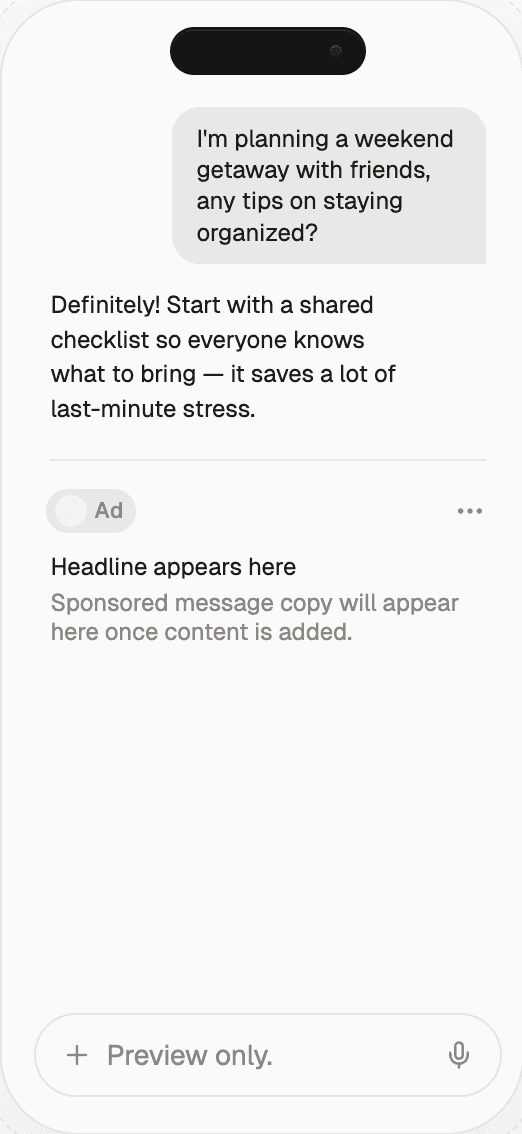
ChatGPT's direct ad program explicitly restricts financial services at launch, with only a narrow approved-advertiser path and minimum spends reported at $250K–$1M. That pushes most fintech activation through independent AI-assistant networks, where compliance guardrails — FINRA 2210 pre-review, SEC Marketing Rule performance carve-outs, UDAAP-aligned claim language, geo-restriction, and mandatory disclaimer rendering — can be enforced at the creative layer before a placement ever fires. Thrad's network is one of the paths available today without waitlist for FINRA-member firms, RIAs, neobanks, and fintech SaaS buyers.







ChatGPT Ads for Fintech — 2026 Compliance Guide | Thrad
Fintech is the hardest vertical to run inside an AI assistant in 2026. OpenAI's first-party ChatGPT ad product gates most financial services out by default, and the categories it does admit carry review overhead measured in weeks. Independent AI-assistant ad networks — the ones that can enforce claim review, disclaimer rendering, and geo-gating at the placement layer — are where most regulated fintech spend actually runs today.
Date Published
Date Modified
Category
Advertising AI
Keyword
chatgpt ads for fintech

Start monetizing your AI app in under an hour
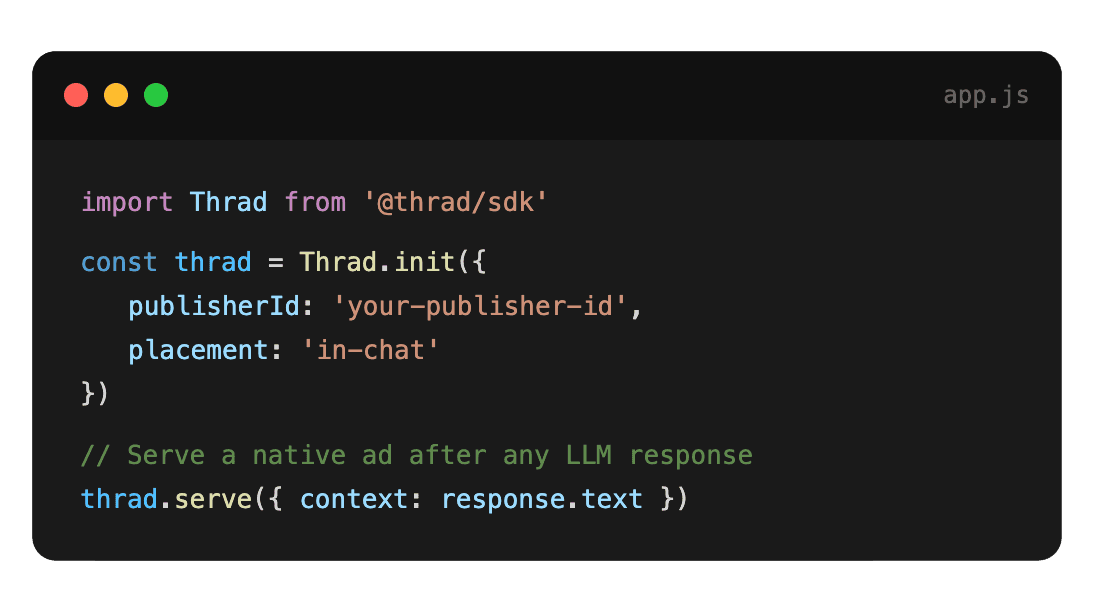
With Thrad, publishers go from first API call to live ads in less than 60 minutes. With fewer than 10 lines of code required, Thrad makes it easy to unlock revenue from your conversational traffic the same day.
Fintech is the hardest advertising category to run inside a generative AI assistant in 2026, and the buyer question is not really "can I run ChatGPT ads for my fintech product" — it's "where can I run AI-assistant ads at all, given my product is restricted on the first-party surface." This article gives the honest answer: OpenAI's direct ad program gates most of financial services out, a narrow approved-advertiser path exists with large minimums, and independent AI-assistant ad networks are where the rest of the category activates today. We'll cover the policy landscape, the regulatory surface (FINRA, SEC Marketing Rule, UDAAP), what compliance controls actually matter at the placement layer, and how fintech marketers pick a network that won't blow up a principal review or a CFPB exam.
What are ChatGPT ads for fintech in 2026?
ChatGPT ads for fintech are paid placements inside ChatGPT's search and conversational surfaces promoting a financial product, service, or platform — subject to OpenAI's restricted-industry policy, which admits only approved financial advertisers and disallows entire subcategories. OpenAI's published ad policy says directly that financial-product and financial-service advertising is restricted, that "at this time, we may allow ads from approved financial advertisers," and that cryptocurrency, credit repair, debt settlement, and debt assistance are disallowed outright.
That policy text is the buyer-facing constraint. Everything that follows in the fintech AI-assistant playbook flows from it.
Why does OpenAI gate fintech so hard?
OpenAI gates fintech on the first-party surface because the answer-trust cost of a non-compliant financial placement is much higher than the incremental ad revenue from admitting the full category. A sponsored search result for a retail product can misfire without eroding user trust in ChatGPT as a whole; a sponsored placement that reads like investment advice, or that omits a past-performance disclaimer on a performance claim, does the opposite. FINRA, SEC, and state regulators all have enforcement muscle that reaches the advertiser, and the CFPB's 2022 UDAAP interpretive rule arguably reaches the intermediary too.
Three constraints are driving the narrow gate on OpenAI direct:
Claim-level review is expensive. Every performance claim needs
a past-performance disclaimer. Every risk claim needs appropriate
hedging. Every comparison needs substantiation. Running that at
volume requires a creative-review workflow OpenAI has only
partially built.Performance-presentation rules are prescriptive. The SEC
Marketing Rule, updated under Rule 206(4)-1, has specific
requirements for how performance can be presented — net vs. gross,
time periods, hypothetical performance labeling — that are hard to
enforce in a short sponsored card without breaking the format.The ad-independence principle raises the bar. OpenAI has
repeatedly stated that ads don't influence the generative answer;
that's easier to preserve when the admitted advertiser pool is
smaller and more heavily vetted.
The net is a policy that is conservative by design, with a long tail of fintech categories outside it. OpenAI's own language is that the restricted set "may expand over time as systems mature" — 2026 is not that moment.
What fintech categories are admitted vs. restricted?
This distinction matters for budget planning. Here is the rough state of the category as of Q2 2026, drawn from OpenAI's published ad policy and commentary from agencies active in the channel:
Fintech subcategory | OpenAI direct (2026) | Typical path |
|---|---|---|
Traditional bank checking / savings | Approved-advertiser path | Direct or independent network |
Credit cards (bank-issued) | Approved-advertiser path | Direct or independent network |
Brokerage / RIA / investment advisory | Approved-advertiser path, heavy review | Independent network more common |
Neobank / fintech SaaS | Approved-advertiser path, gated by minimum spend | Independent network |
Mortgage | Approved-advertiser path, RESPA-aware review | Independent network |
Robo-advisor | Approved-advertiser path, performance-claim review | Independent network |
Cryptocurrency exchange / token / wallet | Disallowed | Not available |
Credit repair | Disallowed | Not available |
Debt settlement / debt assistance | Disallowed | Not available |
Personal lending / BNPL | Limited, heavy UDAAP review | Independent network |
Tax preparation / advisory | Permitted with disclaimers | Direct or independent network |
Financial education (no product push) | Generally permitted | Direct or independent network |
Two observations: most venture-backed fintech SaaS and consumer neobanks sit in the "approved but gated" band, where the gate is a combination of policy review and reported six- to seven-figure minimum commit. And a meaningful chunk of the category — crypto, credit repair, debt — is not bookable on ChatGPT direct at any price.
Which regulations actually govern AI-assistant ads?
Four regulatory regimes govern US fintech advertising in an AI-assistant context, and all four apply to generative-surface placements with no relaxation.
FINRA Rule 2210
Applies to all communications with the public by broker-dealers, "regardless of the channel or format." AI-assistant ads count. Retail communications require principal pre-approval for specified content categories — including performance claims and certain structured-product references. FINRA's 2026 Annual Regulatory Oversight Report, published December 2025, added explicit guidance that communications drafted or delivered by generative AI must meet the same fair-and-balanced, supervision, and retention standards as any other communication. Chatbot outputs to customers are treated as firm communications subject to supervision. That language anchors the AI-assistant ad review in the same framework any FINRA member already operates.
SEC Marketing Rule (Rule 206(4)-1)
Applies to investment advisers. The rule prohibits false or misleading statements, governs how performance can be presented (net vs. gross, time periods, hypothetical performance labeling), and — most relevant to ad brevity — prohibits statements misleading "by omission." That omission test is the hard one in a constrained sponsored-card format, because a performance snippet without the surrounding context can mislead even if each sentence is literally true.
CFPB / UDAAP
The Consumer Financial Protection Act's unfair, deceptive, or abusive acts or practices authority reaches non-bank consumer financial products and the firms that market them. The CFPB's August 2022 interpretive rule — still the governing reading in 2026 — said explicitly that digital marketing firms providing targeting or optimization services to financial advertisers can be liable under UDAAP, and that the "time or space" exception in the statute does not shield modern programmatic or AI-targeted advertising. The 2025 CFPB guidance purge rescinded Circular 2024-01 on preferencing and steering, but statutory UDAAP risk is unchanged.
FTC advertising standards
The FTC's general truth-in-advertising rules apply to every ad in every channel. Claims must be substantiated, disclosures must be "clear and conspicuous," and material conditions must be placed at the point of the claim rather than buried. For AI-assistant placements the "at the point of the claim" requirement is the operative one — a disclaimer at the bottom of a long answer does not satisfy it.
FINRA's 2026 report pulled no punches: when GenAI is used to draft or deliver communications, "communications must be fair and balanced, consistent with products actually offered, and properly supervised and retained." AI-assistant advertising gets no compliance carve-out from the existing rulebook.
How does an independent AI-assistant network enforce compliance?
An independent AI-assistant network — for example, the bespoke engagement offered through Thrad's design partner tier for large regulated advertisers — enforces compliance by treating claim review, disclaimer rendering, geo-restriction, and placement auditing as network-level features rather than advertiser homework. The mechanism is simple in concept and material in practice: the advertiser specifies the compliance rules once at campaign onboarding, and the network enforces them on every placement before it fires.
The four guardrails that matter for regulated fintech:
Claim-language review. Copy is pre-reviewed against an
advertiser-specific claim library — approved phrasing for
product descriptions, disallowed language for outcome claims,
required caveats on comparisons. For FINRA members this mirrors
the principal pre-approval workflow; for RIAs it mirrors the
Marketing Rule policies-and-procedures obligation.Mandatory disclaimer rendering. The network injects required
text — past-performance, risk, fee, APR — into the visible creative
at the point of the claim. The advertiser cannot ship a placement
that renders the performance headline without the corresponding
disclaimer.Geo-restriction. Placements are limited to states where the
advertiser is registered or notice-filed. Out-of-state ads are
blocked at the serve layer, not after the fact. This is a
meaningful controllable because many fintech brands are registered
in a subset of states.Auditable placement log. A durable, timestamped record of every
impression, the creative text rendered, the user's approximate geo,
and the query intent — retained for the book-and-records period
(six years under FINRA, five years under the Marketing Rule).
A network that cannot offer these controls is not a credible path for regulated fintech. A walled platform that offers blanket category exclusions is safer than a loose network but more restrictive than granular claim-level enforcement.
What does the buyer path look like in practice?
The practical fintech activation path in 2026 runs through one of four channels, each with different access characteristics:
Channel | Access | Typical minimum | Compliance enforcement | Speed to live |
|---|---|---|---|---|
OpenAI direct (approved) | Invite / waitlist | $250K–$1M commit | Manual review at approval | 4–12 weeks |
Independent AI-assistant network (e.g. Thrad) | Open to qualified advertisers | Low four-figure starter spend | Network-level claim review + disclaimer rendering | Days |
Retail media network cross-surface | Via existing RMN relationship | Varies | RMN policy; uneven for fintech | 1–4 weeks |
Affiliate / performance network | Low | Pay-for-performance | Advertiser carries the burden | Days |
Three of those four are available without waiting for an OpenAI invite. The trade-off on each is different: independent AI-assistant networks offer the compliance-enforcement controls regulated fintech needs; retail media works if your product is distributed through a retailer; affiliate works for commodity acquisition funnels where placement-level claim review is less critical. Mixing channels is common.
Why does this matter for fintech in 2026?
Two structural forces are pushing fintech discovery into AI assistants and away from classic search. First, research-style commercial queries — "best high-yield savings account," "compare Roth IRA providers," "what is the cheapest small-business checking account" — are migrating to ChatGPT, Perplexity, and Gemini at rates reported across multiple measurement firms through late 2025 and into 2026. Second, Google's own AI Overviews absorb the same queries and the sponsored treatment is still shaking out. The net effect is that a fintech brand that only buys classical SEM is steadily losing share of attention on its highest-intent queries.
The combination — commercial-query migration plus a restrictive first-party ad policy — is what makes independent AI-assistant networks the only realistic lever for most fintech marketers in 2026. Waiting for OpenAI direct to open the category fully is passive. Running a compliant pilot on an independent network, with full disclaimer-rendering and placement audit trail, is the active alternative that lets a fintech brand measure the channel without regulatory exposure.
Common misconceptions
"My fintech is approved on ChatGPT because we passed the ad review once." Policy and eligibility drift; approved categories have been narrowed mid-year on other platforms and can be here. Treat approval as rolling, not permanent.
"Past-performance disclaimers can go in a landing-page footer." The FTC and SEC expectation is clear-and-conspicuous placement at the point of the claim. Footer-only disclaimers are high-risk on AI-assistant creative.
"An AI-generated ad isn't a FINRA 2210 communication." FINRA's 2026 report contradicts this directly. GenAI output used in external communications is a communication subject to supervision and retention.
"Cryptocurrency is permitted if I call it a fintech product." OpenAI's policy disallows cryptocurrency, credit repair, debt settlement, and debt-assistance services by name. Rebranding does not get around the exclusion.
"UDAAP only applies to the advertiser, not the network." The 2022 CFPB interpretive rule — still governing guidance in 2026 — said digital marketing firms providing targeting services to financial advertisers can be liable. Network selection matters.
"Independent networks skip the compliance hard work." The opposite: the networks that serve regulated fintech do more compliance work at the placement layer than OpenAI direct does, because they have to. A network without claim review and disclaimer rendering is not a fit.
What comes next
Expect three shifts through the remainder of 2026 and into 2027. First, OpenAI's restricted-industry list will likely loosen incrementally — probably first on the subcategories with the cleanest compliance stories (traditional bank accounts, mortgage with RESPA alignment, brokerage with Marketing Rule disclosures), and last on the currently-disallowed set (crypto, credit repair, debt).
Second, measurement standardization will tighten. IAB Tech Lab and MRC are actively publishing generative-surface guidance, and fintech-specific addenda on disclaimer-rendering and performance-claim presentation are likely. Advertisers who already ran on networks with auditable placement logs will be best positioned when the specs formalize.
Third, the enforcement environment will test the intermediary. The first UDAAP, FINRA, or SEC action that names an AI-assistant ad network alongside an advertiser will set the tone for the channel. Fintech marketers should pick a network that can survive that test — i.e., one that treats claim review as product surface, not as customer-support escalation.
How to get started with fintech AI-assistant advertising
The practical first step is a compliance-first channel audit. Inventory your top 20 commercial-intent prompts — the ones your prospects actually type — and map each to an assistant surface (ChatGPT, Perplexity, Gemini, Copilot). For each, test whether a sponsored response is rendering today, whether an organic citation to your brand is present, and whether your competitors are active.
Second, set up the compliance scaffolding regardless of channel choice: the approved claim library, the mandatory disclaimer set, the geo-registration matrix, and the principal pre-approval or policies-and-procedures workflow. This work pays off on every channel — direct or independent — and it's the long-pole item in most fintech onboardings.
Third, pilot on an independent AI-assistant network where the compliance controls are native. Thrad's network lets a FINRA-member firm, RIA, neobank, or fintech SaaS run regulated-category placements with claim review, disclaimer rendering, geo-gating, and a durable placement log built in — without the OpenAI-direct minimum commit and without the waitlist. The pilot size and category exposure stay proportionate to your risk budget, and the measurement stack is the same you would use anywhere else.
For teams that can wait, OpenAI direct will keep opening. For teams that need to measure AI-assistant ad performance now, the path runs through an independent network with compliance guardrails at the placement layer. Both can co-exist in a 2026 fintech media plan — but only one is available today without a six- or seven-figure handshake.

ai assistant advertising for fintech, finra compliant chatgpt ads, sec marketing rule ai ads, fintech ad network
Citations:
OpenAI, "Ads in ChatGPT — Help Center," 2026. https://help.openai.com/en/articles/20001047-ads-in-chatgpt
OpenAI, "Our approach to advertising and expanding access to ChatGPT," 2026. https://openai.com/index/our-approach-to-advertising-and-expanding-access/
FINRA, "2026 Annual Regulatory Oversight Report," December 2025. https://www.finra.org/sites/default/files/2025-12/2026-annual-regulatory-oversight-report.pdf
McGuireWoods, "FINRA's 2026 Annual Regulatory Oversight Report: New Focus on AI," December 2025. https://www.mcguirewoods.com/client-resources/alerts/2025/12/finras-2026-annual-regulatory-oversight-report-same-priorities-new-focus-on-ai-and-cybersecurity/
Single Grain, "ChatGPT Ads for Financial Services: Compliance with FINRA and SEC Regulations," 2026. https://www.singlegrain.com/advertising/chatgpt-ads-for-financial-services-compliance-with-finra-and-sec-regulations/
Adventure PPC, "ChatGPT Ads for Financial Services: Navigating Fintech Advertising Rules in 2026," 2026. https://www.adventureppc.com/blog/chatgpt-ads-for-financial-services-navigating-fintech-advertising-rules-in-2026
Covington & Burling, "CFPB Interpretive Rule — UDAAP Restrictions Apply to Digital Marketing Firms," 2022 (still governing guidance in 2026). https://www.cov.com/en/news-and-insights/insights/2022/08/cfpb-interpretive-rule-suggests-udaap-restrictions-apply-to-digital-marketing-firms
TechCrunch, "ChatGPT rolls out ads," February 2026. https://techcrunch.com/2026/02/09/chatgpt-rolls-out-ads/
Sidley Austin, "FINRA Issues 2026 Regulatory Oversight Report," December 2025. https://www.sidley.com/en/insights/newsupdates/2025/12/finra-issues-2026-regulatory-oversight-report
Be present when decisions are made
Traditional media captures attention.
Conversational media captures intent.
With Thrad, your brand reaches users in their deepest moments of research, evaluation, and purchase consideration — when influence matters most.