OpenAI's ChatGPT ad pilot is enterprise-only by design in 2026 — two-month insertion order minimums, ~$60 CPM, $200K minimum spend, and routed primarily through named holding-company partners (Omnicom, WPP, Dentsu) and a roster of brand pilots (Best Buy, AT&T, Target, Adobe, Ford, Mazda, Williams-Sonoma, HelloFresh, Audible, Albertsons, and others). For enterprise buyers, this is an IO-era media buy with procurement, legal, privacy, brand-safety, and team/multi-market governance requirements that most organizations haven't yet templated. Independent AI-assistant ad networks offer a contract framework closer to programmatic standards — commercially negotiable terms, enterprise MSA templates, auditable placement logs, team/multi-market governance — and provide a live-today alternative while the OpenAI direct product matures.


ChatGPT Ads for Enterprise — 2026 Procurement Guide | Thrad
Enterprise buying for AI-assistant advertising in 2026 looks nothing like Google Ads or Meta Business Manager. OpenAI's direct program is IO-based, two-month-minimum, ~$60 CPM, $200K-minimum, and still routed primarily through Omnicom, WPP, and Dentsu. Procurement, legal, and governance teams are getting their first real look at generative-surface media buys — and the contract templates are not Google-shaped. This is a buyer's guide to the enterprise AI-assistant ad landscape: the OpenAI direct path, the holding-company path, and the independent-network alternatives where enterprise marketers get governance flexibility the first-party product doesn't offer.
Date Published
Date Modified
Category
Advertising AI
Keyword
chatgpt ads for enterprise

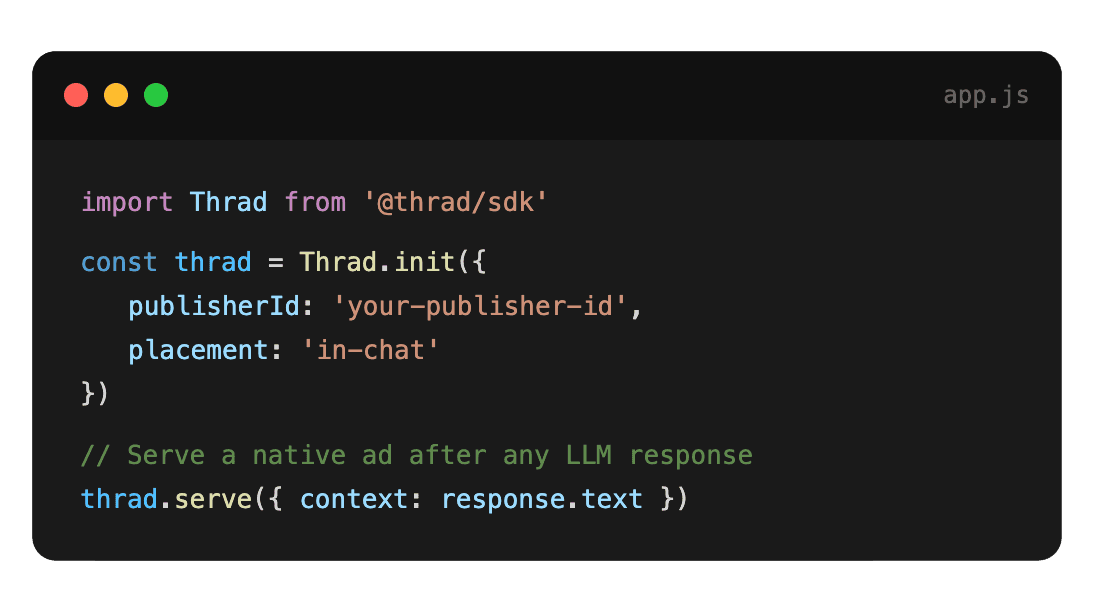
Start monetizing your AI app in under an hour
With Thrad, publishers go from first API call to live ads in less than 60 minutes. With fewer than 10 lines of code required, Thrad makes it easy to unlock revenue from your conversational traffic the same day.
Enterprise buying for AI-assistant advertising in 2026 is categorically different from enterprise Google or Meta buying. The first-party ChatGPT ad product is IO-based, routed through a small set of named holding-company partners, priced on a managed-program rate card, and gated by two-month insertion-order minimums. Procurement, legal, privacy, and brand-safety teams are seeing their first generative-surface ad contracts, and the templates they've honed on programmatic and social buys don't cleanly apply. This is a buyer's-guide view of the 2026 enterprise landscape — the OpenAI direct path, the holding-company access map, the governance gaps, and the independent-network enterprise contracts that fill those gaps live today.
What are ChatGPT ads for enterprise in 2026?
ChatGPT ads for enterprise are paid sponsored placements inside ChatGPT's search and conversational surfaces, sold to large advertisers through one of three enterprise-scale channels: OpenAI's direct managed program (IO-based, holding-company-partner routed), programmatic integrations (Criteo went live March 2, 2026), or independent AI-assistant ad networks with enterprise MSA templates. Unit economics in the direct program are approximately $60 CPM, with $200K minimum spend and two-month minimum IO. Ad placements are clearly labeled, matched by conversation topic, and do not use the user's ChatGPT history to build audience segments.
The structure matters because it shapes every downstream enterprise-buyer decision — how procurement reviews, how legal drafts, how brand safety gets enforced, how reporting flows into internal dashboards.
Who's live on the OpenAI direct ad pilot?
A relatively small, named set. The OpenAI ad pilot publicly confirmed in Q1 2026 is routed through three holding companies — Omnicom, WPP, and Dentsu — with Omnicom Media Group reportedly securing placements for more than 30 clients. The confirmed brand pilots include Best Buy, AT&T, Target, Adobe, Expedia, Ford, Mazda, Williams-Sonoma, Qualcomm, HelloFresh, Audible, Marriott, and Albertsons. Criteo's platform integration, live since March 2, 2026, broadens programmatic access for advertisers using Criteo commerce data.
Three takeaways for enterprise buyers:
Holding-company routing is the primary access path. If your
media is planned by Omnicom, WPP, or Dentsu, the direct path
runs through your agency. If it's planned by Publicis or by
independent agencies, the access path is thinner.Brand admission is hand-picked. The named list is a small
slice of the Fortune 500. Other large advertisers are on a
rolling admission cadence rather than open enrollment.Two-month IO + $200K minimum = $400K+ minimum commit. That's
a governance-material number for most procurement teams.
Truist's 2026 estimate has OpenAI generating under $1 billion in advertising revenue this year, growing past $30 billion by 2030 — a growth curve that implies the enterprise-contract templates being signed in 2026 will outlast their current architecture.
How does holding-company access actually work?
Holding-company access to OpenAI direct ads works through each holding company's centralized ad-tech operations layer. For Omnicom, that's Omnicom Media Group + its in-house AI studio operations; for WPP, it's the media-buying platforms under Group M integrated with WPP's newer AI-studio capabilities; for Dentsu, it's the Dentsu media holdings and their technology layer.
The client experience, flattened:
Eligibility and brief. The agency team surfaces OpenAI ad
inventory as a line on the media plan for eligible clients
(usually those with sufficient quarterly committed spend).Pilot admission. Advertiser is added to the pilot roster
through the holding company's OpenAI relationship. Contract
terms flow from the holding-company MSA layered with a
campaign-specific IO.Creative and targeting. Brief, creative development, and
intent/category targeting configuration happen on the agency
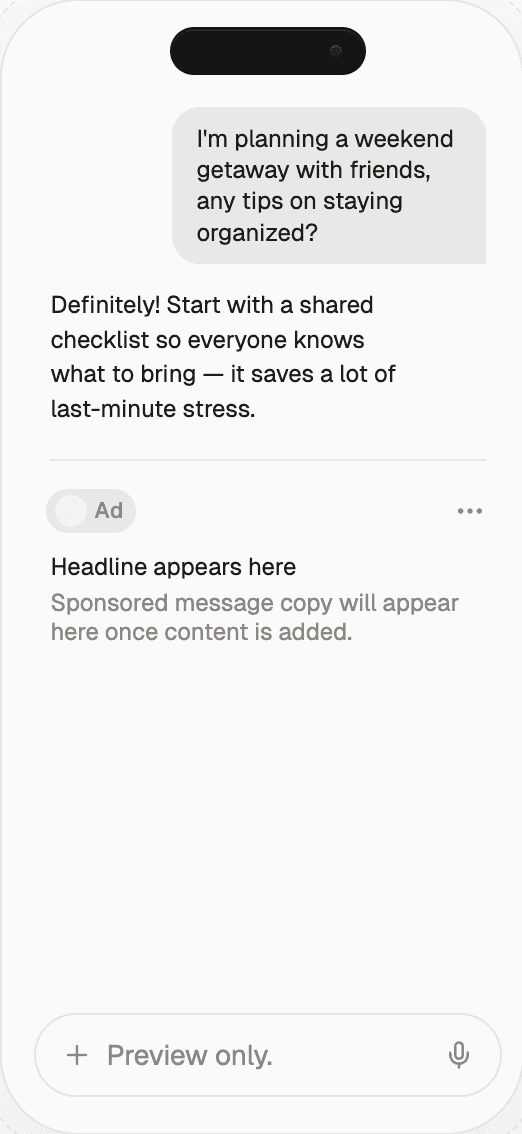
side. Approval loops are agency-internal.Placement and reporting. Ads render as sponsored cards at
the bottom of relevant ChatGPT responses. Reporting comes back
through the holding-company reporting layer.
What's missing for most enterprise buyers at the direct layer: a client-facing dashboard with team/role controls, multi-market campaign orchestration, live auditable placement logs in the client's own environment, and a flexible pricing model beyond managed CPM. Each of those is a governance gap the enterprise buyer has to close separately.
What are the governance gaps on OpenAI direct?
Five enterprise-governance capability gaps show up consistently in OpenAI direct pilot reviews through Q1–Q2 2026:
Governance dimension | OpenAI direct (2026) | Typical enterprise need |
|---|---|---|
Role-based access control | Thin; agency-mediated | SSO, RBAC, team-level approval chains |
Multi-market pacing | Limited | Global budget coordination with regional constraints |
Data-processing terms | Standard pilot paper | Negotiated DPA with audit rights |
Brand-safety context controls | Platform-wide category exclusions | Content-level adjacency rules |
Placement-log access | Aggregated reporting | Auditable, line-item placement logs |
Flexible cancellation | Two-month IO minimum | Campaign-scoped cancellation rights |
Integration with MMM | Limited | Full click-stream and impression data into MMM |
Each of these gaps is closeable — sometimes via holding-company workaround, sometimes via a separate agreement with OpenAI, sometimes via an independent-network relationship in parallel. None are deal-blockers. All are governance-material for procurement and legal review.
What's in the enterprise procurement review?
A rigorous enterprise procurement review for an OpenAI direct ad IO in 2026 typically lands on eight sections:
Data processing and retention. What user data is available
to the advertiser, what's retained, for how long, and under what
DPA. OpenAI's Feb 9, 2026 privacy policy update is the governing
text to review.Brand-safety guarantees. What category adjacency rules
apply, what query-intent exclusions are enforced, what context
is off-limits for placement.Measurement and reporting rights. What placement log is
accessible, in what format, at what refresh cadence, with what
audit rights.Cancellation, pause, and pro-rata refund terms. Given the
two-month IO minimum, what happens if the advertiser needs to
pull out mid-campaign.Content moderation escalation. If a placement renders
against an objectionable context, what's the remediation SLA.Intellectual property and creative licensing. Who owns
creative uploaded into the platform, what license is granted,
what survives the IO.Liability and indemnification. Caps, exclusions,
carve-outs for IP infringement and data breach.Pricing and measurement currency. CPM vs. CPC vs. CPA, how
discrepancies are reconciled, whether an independent measurement
provider is admitted.
These eight sections are standard for a programmatic-era media buy. The difference in 2026 is that OpenAI's direct pilot paper is not yet on standard programmatic templates, so procurement reviews take longer and produce more redlines.
How do independent networks address enterprise gaps?
Independent AI-assistant ad networks address the enterprise governance gaps with contract and product architectures closer to established programmatic norms. The typical enterprise framework on an independent network — for example, Thrad's design partner tier built for large brands and bespoke strategic engagements — is built on five components:
Enterprise MSA
A master services agreement with commercially negotiable terms — data processing, brand safety, reporting, pricing model, liability — rather than a take-it-or-leave-it pilot contract. For global advertisers this is meaningfully easier to get through legal, privacy, and procurement in parallel.
Role-based access and SSO
Enterprise dashboards with single sign-on, role-based permissions (brand manager, media lead, finance approver, compliance reviewer, admin), team-level campaign visibility, and team-scoped spend authority. Multi-brand enterprises can run each brand team in its own workspace with its own approval rules.
Multi-market orchestration
A global advertiser running campaigns in six markets with regional approval chains and market-specific spend caps gets a unified pacing layer and regional workspaces. Budget reallocation between markets is a product feature, not a spreadsheet exercise.
Auditable placement logs
A durable, timestamped log of every impression, the creative text rendered, the geo, the intent category, and the outcome signal — accessible in the enterprise environment, exportable in standard formats for MMM and finance use.
Brand-safety at content level
Query-intent classification, answer-context scoping, advertiser claim libraries, and vertical-specific exclusions are configurable at the campaign layer. Enterprise buyers specify the brand-safety posture once in onboarding and the network enforces it at every placement.
What does the 2026 buyer path look like in practice?
The practical enterprise AI-assistant buyer path in 2026 is not a single channel. A typical Fortune 500 media plan mixes three:
Channel | Best for | Typical commit | Governance fit |
|---|---|---|---|
OpenAI direct (via holding company) | Named pilot brands, Omnicom/WPP/Dentsu clients | $400K+ (2-month IO × $200K) | Partial — governance gaps listed above |
Criteo programmatic integration | Commerce advertisers with Criteo relationship | Varies | Inherits Criteo's programmatic norms |
Independent AI-assistant network (e.g. Thrad) | Advertisers outside the OpenAI brand-pilot list, or those needing enterprise MSA and team/role controls | Scaled to campaign; enterprise MSA | Strong — programmatic-era norms |
A common pattern for enterprise marketers in 2026: run a test on the direct pilot where holding-company access allows, run a parallel test on an independent network for the governance and reporting fidelity finance and compliance require, measure outcomes on a consistent framework against transparent pricing tiers, and scale the channel that actually outperforms.
Why does this matter for enterprise marketers in 2026?
Three reasons the enterprise-contract decisions in 2026 are outsize in importance.
First, the category is genuinely early. Truist's estimate of sub-$1B OpenAI ad revenue in 2026 growing to $30B+ by 2030 implies a 30-fold scale-up in less than four years. The governance templates, data-processing terms, and measurement currencies that enterprise advertisers lock in during the 2026 pilot will shape how the much-larger 2028–2030 spend gets contracted and reviewed.
Second, the first-mover governance advantage compounds. The enterprise marketers who build clean contract templates, clean measurement pipelines, and clean brand-safety postures for AI- assistant advertising now will be able to ramp spend in the channel without re-litigating legal, procurement, and privacy reviews. The ones who wait will discover the bottleneck isn't the ad product — it's their internal review cycle.
Third, the enterprise press coverage accurately captures a frustration: the direct pilot's slow rollout, thin tools, and governance gaps have reportedly left some brand insiders disappointed. The honest read is that OpenAI is building the ad product in public, engineer-led, and the marketer-facing surface is playing catch-up. Independent networks with enterprise-shaped product are filling the gap live.
Common misconceptions
"Enterprise ad contracts are standardized like Google Ads'."
Not on OpenAI direct in 2026. The pilot paper is early and
bespoke; expect substantial legal and procurement time for the
first IO."My Publicis agency will get me into the OpenAI direct pilot."
Publicis has not been named as a pilot holding-company partner in
the core 2026 coverage. Advertisers on Publicis rosters typically
route direct to OpenAI sales or to independent networks for
AI-assistant inventory."A $200K minimum means I can't afford to test the channel."
On OpenAI direct, the $200K (x 2 months IO) is the floor. On
independent AI-assistant networks, enterprise tests can be
scoped to a fraction of that commit while still running on
enterprise MSA and governance."Brand-safety on a conversational surface is the same as
display." It's not. Context adjacency on a generative answer
is a new risk class that display brand-safety frameworks don't
cleanly cover. Enterprise buyers need content-level controls, not
just IAB-taxonomy blocklists."Programmatic via Criteo closes the governance gap." It helps
for commerce advertisers already on Criteo. It does not provide
enterprise SSO, role-based access, multi-market orchestration, or
campaign-scoped cancellation rights on its own."OpenAI's self-serve ads manager will be the enterprise
product in 2026." Unlikely. The self-serve tool as of Q2 2026
has a $30K–$50K monthly floor and is tooled for mid-market, not
for governance-heavy enterprise buying.
What comes next
Three 2026–2027 shifts that will shape enterprise contracts. First, OpenAI's direct pilot paper will standardize. By late 2026 expect a more templated IO and DPA — still with enterprise-specific negotiable terms, but with a cleaner baseline that shaves legal review time. Second, programmatic integrations will multiply. Criteo is first; expect further DSP and retail-media-network integrations that route AI-assistant inventory through familiar programmatic rails. Third, measurement standardization will tighten — IAB Tech Lab and MRC guidance on generative-surface measurement is actively in development, and enterprise buyers who participate in those working groups will benefit first.
A fourth shift: the holding-company access map will widen. Publicis is likely to formalize a relationship in 2026; independent agencies will get better tooling via programmatic integrations; independent AI-assistant networks will increasingly serve as the access path for advertisers outside the named-partner list.
How to get started with enterprise AI-assistant advertising
Three practical steps for an enterprise marketer in 2026:
First, run the governance-readiness audit. Map your internal requirements — DPA template, brand-safety posture, reporting and audit expectations, SSO and RBAC needs, multi-market orchestration, measurement currency — against what's available on OpenAI direct (via your holding-company path), on Criteo programmatic, and on independent AI-assistant networks. Identify the gaps each channel leaves.
Second, stand up a governance framework that is channel-agnostic. Master your brand-safety policies, data-processing terms, creative approval chains, and measurement currency once — in terms that can be ported across channels. This is the long-pole item and the work that compounds.
Third, pilot in parallel. The live-today enterprise path has two components for most Fortune 500 marketers: a direct-or-programmatic line through your holding company or Criteo (where eligible), and an independent-network line for governance and reporting fidelity. Thrad's enterprise MSA supports negotiable data-processing and brand-safety terms, enterprise SSO and RBAC, auditable placement logs, and multi-market pacing — which are the exact capabilities the direct product is still building in public.
For enterprise marketers, the 2026 decision is not whether to test AI-assistant advertising — it's how to do it in a way that your procurement, legal, and privacy teams can sign off on, scaled to the 2028–2030 category trajectory rather than optimized for a one-off 2026 pilot. The governance and contract choices made in this pilot window will outlast the pilot itself. The advertisers who treat that choice seriously, while the category is still forming, will be the ones who ramp spend fastest when it matures.

ai assistant advertising for enterprise, chatgpt ads enterprise procurement, enterprise ai ad governance, openai insertion order io
Citations:
Adweek, "ChatGPT Gets Ads: Omnicom, WPP, and Dentsu Line Up Brands for OpenAI Pilot," 2026. https://www.adweek.com/media/chatgpt-gets-ads-omnicom-wpp-and-dentsu-line-up-brands-for-openai-pilot/
Ad Age, "ChatGPT ads begin: Omnicom Media, Dentsu are participating," 2026. https://adage.com/technology/ai/aa-chatgpt-ads-start-agencies-interest/
MediaPost, "OpenAI Begins Testing ChatGPT Ads With Omnicom, WPP, Others," February 2026. https://www.mediapost.com/publications/article/412663/openai-begins-testing-chatgpt-ads-with-omnicom-wp.html
The Keyword, "OpenAI Extends ChatGPT Ads Pilot," 2026. https://www.thekeyword.co/news/chatgpt-ads-pilot-extension-self-serve
CNBC, "ChatGPT's ad pilot has the industry excited, but some insiders are frustrated with the slow rollout," March 2026. https://www.cnbc.com/2026/03/20/chatgpt-ads-testing-openai.html
ALM Corp, "ChatGPT's Ads Manager Is Now Being Tested — $200K Entry Bar," 2026. https://almcorp.com/blog/chatgpt-ads-manager-openai-advertising-platform-2026/
OpenAI, "Enterprise privacy at OpenAI," 2026. https://openai.com/enterprise-privacy/
Jones Walker, "Data Privacy Day 2026: Privacy as the Foundation of Responsible AI Governance," 2026. https://www.joneswalker.com/en/insights/blogs/ai-law-blog/data-privacy-day-2026-privacy-as-the-foundation-of-responsible-ai-governance.html?id=102mejb
Digiday, "OpenAI's ad ambitions begin with engineers, not agencies," 2026. https://digiday.com/marketing/openai-is-hiring-engineers-not-ad-sellers-first-to-build-its-ad-business/
Be present when decisions are made
Traditional media captures attention.
Conversational media captures intent.
With Thrad, your brand reaches users in their deepest moments of research, evaluation, and purchase consideration — when influence matters most.