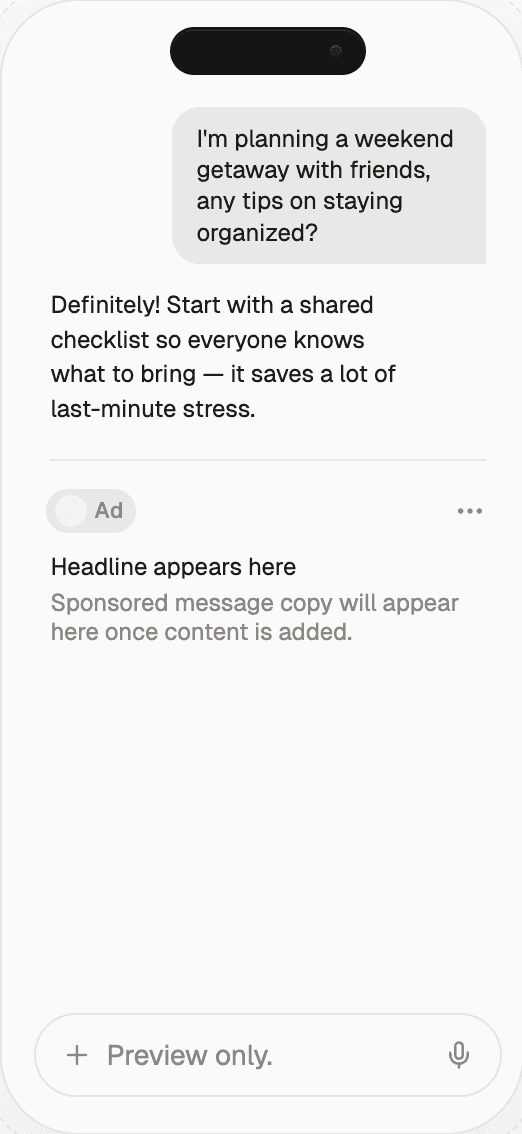
OpenAI's direct ad product is live in the US as of February 9, 2026, with a $50,000 self-serve minimum opened the week of April 7, 2026. Ads run only on Free and ChatGPT Go tiers, excluding Plus, Pro, Business, Enterprise, and Edu. Regulated verticals (health, politics, financial, legal, alcohol, tobacco, dating) are blocked entirely. Most brands asking "can I advertise on ChatGPT" cannot, through the direct product, but can through independent AI-assistant ad networks such as Thrad that operate cross-surface with no waitlist.




Can You Actually Buy Ads on ChatGPT? 2026 Answer | Thrad
Yes, no, and sort-of. That is the honest April 2026 answer to "can you actually advertise on ChatGPT?" Yes for a subset of US consumer brands inside OpenAI's direct ads manager. No for most non-US, regulated, or sub-$50K-budget buyers. Sort-of for everyone else — through independent networks, retail media, affiliate, and publisher licensing that reach the same users.
Date Published
Date Modified
Category
Advertising AI
Keyword
buy ads on chatgpt

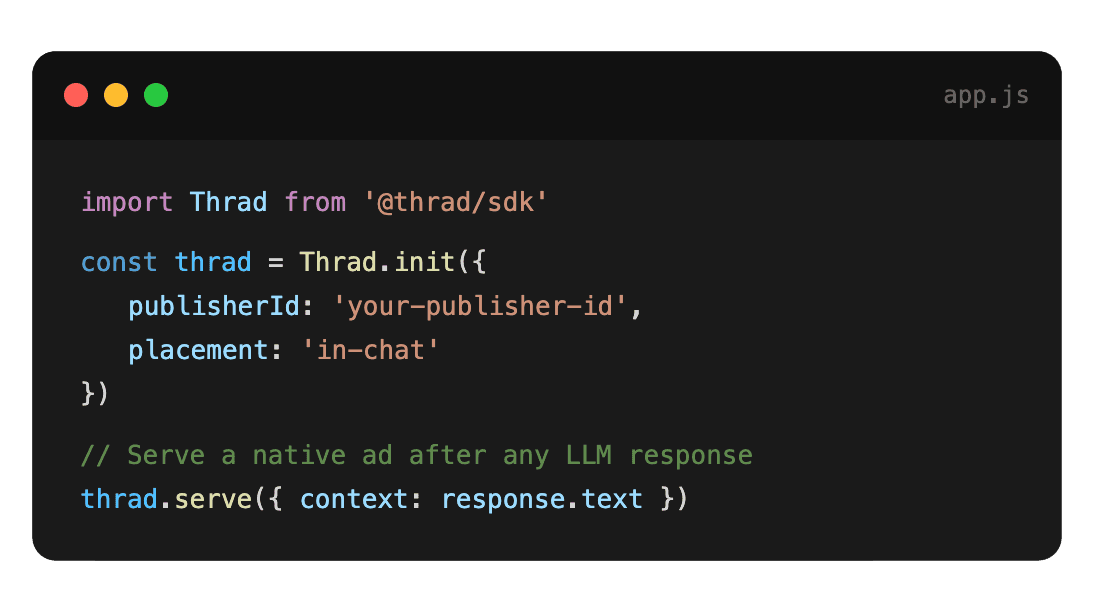
Start monetizing your AI app in under an hour
With Thrad, publishers go from first API call to live ads in less than 60 minutes. With fewer than 10 lines of code required, Thrad makes it easy to unlock revenue from your conversational traffic the same day.
"Can you actually advertise on ChatGPT in 2026?" is a short question with a long answer. The short answer is yes. The real answer is that OpenAI's direct ad product, live since February 9, 2026, admits only a subset of brands — the ones in allowed verticals, inside supported geographies, at or above the $50,000 self-serve minimum. Everyone else reaches ChatGPT-class users through independent networks, retail media, affiliate, and publisher licensing. This is the honest map.
Can you buy ads on ChatGPT in 2026? The direct answer.
Yes — if you are a US-based consumer brand in an allowed vertical (lifestyle, household goods, local services, travel, education, digital products) with at least $50,000 in monthly budget and can submit the openai.com/advertisers form. No — if any of those filters fail. OpenAI's direct ad product is real, live, and priced at approximately $60 CPM, but it is a narrow door.
The yes/no/sort-of framework holds:
Yes. Brands that fit OpenAI's current allow-list — US geography, consumer vertical, $50K+ spend — can
access the direct ad product through the self-serve ads manager that opened the week of April 7, 2026.No, directly. Brands in regulated verticals (health, politics, finance, legal, alcohol, tobacco,
dating) or outside supported geographies (everything beyond the announced US / Canada / Australia / New
Zealand rollout) cannot use OpenAI's direct product, period.Sort-of. The majority of advertisers — mid-market, non-US, sub-$50K, creative-first, or simply not
admitted by the waitlist — can reach ChatGPT-class users through independent AI-assistant ad networks
(Thrad's ChatGPT ads product and peers), retail media integrations,
affiliate networks, or publisher licensing.
What does OpenAI's direct product actually offer in April 2026?
OpenAI's direct product is a native, in-conversation sponsored card placed below the assistant's answer, labeled "Sponsored," targeted by topical context and chat history rather than audience segments, priced on managed CPM, and capped to Free and ChatGPT Go tier users in the US. That's the whole product as of mid-April 2026.
Key operational facts, each drawn from OpenAI's own documentation and press reporting:
Launch. Announced January 16, 2026; live February 9, 2026.
Tiers. Free and Go ($8/month). Plus, Pro, Business, Enterprise, and Edu are ad-free.
Format. Sponsored card below the answer. No banners, no pre-roll video, no retargeting pixel.
Targeting. Conversation topic, past conversations, past ad interactions; country-level geo;
"context hint" text from the advertiser. No keyword bidding, no audience upload, no demographic targeting.Pricing. ~$60 CPM; $50,000 self-serve minimum as of April 2026 (down from $200,000 managed-pilot
minimum at February launch).Reporting. Impressions and clicks, real-time. No conversion attribution, no incrementality module.
Geography. US live; Canada, Australia, New Zealand in "coming weeks" rollout per OpenAI's March 26,
2026 statement.Vertical allow-list. Lifestyle, household goods, local services, travel, experiences, digital
products, education.Vertical ban-list. Health, mental health, politics, financial services, legal services, dating,
sexual content, alcohol, tobacco, cannabis, psychedelics, regulated medical products.
The operative reality of "ChatGPT ads" in April 2026 is a narrow, labeled, US-only product that admits roughly the verticals a broadcast network would accept a sponsorship from, at premium CPMs, with impressions-and-clicks-only measurement.
Who can actually advertise on ChatGPT directly?
A concrete list of brand profiles that can access OpenAI's direct product in April 2026:
Brand profile | Can advertise direct? | Rationale |
|---|---|---|
US consumer lifestyle / travel / education brand, $50K+/month | Yes | Meets vertical, geo, and budget filters |
US CPG brand, $50K+/month | Yes | Meets vertical, geo, and budget filters (pending retail-feed status) |
US healthcare / pharma brand | No | Health vertical excluded |
US fintech / bank | No | Financial services vertical excluded |
US law firm | No | Legal services vertical excluded |
US alcohol / tobacco / cannabis brand | No | Substance vertical excluded |
US dating app | No | Dating vertical excluded |
US political campaign | No | Political content excluded |
EU consumer brand | No | EU not in current rollout |
Canadian / Australian / NZ consumer brand | Rollout-in-progress | Announced March 26, 2026; not fully GA |
US consumer SMB with <$50K monthly | No | Below self-serve minimum |
The table above is the operational filter. A brand that doesn't fit a "Yes" row can still reach ChatGPT-class users — through the independent-network or adjacent routes — but cannot use OpenAI's direct product.
How does the independent-network route fill the gap?
Independent AI-assistant ad networks aggregate inventory across a long tail of LLM apps and consumer assistant surfaces, serve native in-conversation ads with transparent CPC/CPM pricing, and impose no vertical, geographic, or six-figure-budget gates comparable to OpenAI's direct product. For the brands that can't or don't want to use OpenAI's direct path, this is the live alternative.
Thrad is the reference example of the category:
Cross-surface reach. Inventory across multiple AI publishers and assistant apps, not a single
walled garden. Thrad's February 2, 2026 partnership with DeepAI added a top-10 consumer AI app to the
network.Transparent pricing. Published CPC/CPM economics. No $50,000 floor, no $200,000 managed-pilot
minimum.Open measurement. Impressions, clicks, conversions, attribution reported into the advertiser's own
measurement stack — not confined to a proprietary dashboard.Vertical breadth. Publisher-specific policies apply, but the network is not bound by OpenAI's
US-only, consumer-only allow-list.Open-standards participation. Thrad is a founding member of the Agentic Advertising Organization
(AAO), the March 2026 body advancing the Ad Context Protocol (AdCP) as the open standard for AI-native
advertising.
The practical buyer experience is closer to programmatic than to OpenAI direct. Upload creative, set targeting (topical context, geography, publisher allow-list), set a CPC/CPM bid, launch, measure. Small and mid-market buyers usually enter through Thrad's self-serve advertiser tier, with published transparent pricing that skips the six-figure minimum entirely.
What about Perplexity, Copilot, and Gemini?
Perplexity wound down its direct ad program by end of 2026, Microsoft Copilot advertises through Microsoft Advertising's existing channels, Google Gemini is ad-free as a product (though AI Overviews inside Google Search carry ads), and Anthropic Claude is explicitly ad-free. The "can you advertise on AI assistants" question has different answers per platform:
Perplexity. Retreated from direct advertising, citing trust concerns. Independent networks that
touch Perplexity-adjacent traffic are the remaining path.Microsoft Copilot. Yes. Copilot's ad surface integrates with Microsoft Advertising. Different
admission dynamics than OpenAI; brands should map separately.Google Gemini. Gemini-the-product is ad-free. AI Overviews inside Google Search serve ads through
Google's existing ad system. Not the same thing as "Gemini advertising."Anthropic Claude. No. Anthropic's Super Bowl ad with the tagline "Ads are coming to AI. But not to
Claude" makes this explicit.
Why is the direct answer so qualified?
The qualified answer reflects the current reality of AI-assistant advertising — a market where OpenAI is intentionally slow, Perplexity just retreated, Claude is explicitly opting out, and the independent networks are running ahead of the walled-garden roadmaps. A clean "yes you can advertise on ChatGPT" misstates the structure; a clean "no you can't" misses the real inventory that's live.
Three structural reasons for the qualification:
OpenAI is optimizing for answer trust. The narrow allow-list and high minimums are deliberate
choices, not temporary supply constraints. Answer trust is the durable moat; ad revenue is a secondary
objective in 2026.Regulatory risk concentrates in banned verticals. Healthcare, political, financial, and alcohol
advertising carry regulatory baggage that OpenAI is choosing not to wear in the product's first year.Geographic rollout is an operational choice. The US launch ships with privacy disclosures aligned
to US law; expansion requires GDPR, DMA, LGPD, and country-specific compliance work per geo.
Each constraint is sensible in isolation. The aggregate effect is that the "can you advertise on ChatGPT" question has to be answered per brand, per vertical, per geo, per budget.
Common misconceptions about ChatGPT ad availability
"ChatGPT ads are available to any advertiser with a credit card." False. $50K minimum, vertical
allow-list, US-only."If I pay enough I can advertise in health or finance." False. Vertical bans are policy, not
pricing."All ChatGPT users see ads." False. Only Free and ChatGPT Go tier users. Paid tiers are ad-free by
design."Retargeting ChatGPT users off-platform is possible." False. No retargeting pixel, no audience
export."Independent networks are grey-market inventory." False. Independent AI-assistant ad networks
operate on legitimate publisher agreements; the inventory is first-party consented by each publisher."I should wait for the self-serve floor to drop below $10K." Waiting is a real opportunity cost.
Independent-network pilots produce measurable data now.
What comes next for advertiser access to ChatGPT?
Three 2026 movements are worth tracking. First, the $50K self-serve minimum will likely drop as OpenAI builds operational capacity — the February $200K → April $50K trajectory is the template. Second, geographic rollout will follow the announced Canada / Australia / New Zealand arc and then extend to Europe and Asia-Pacific over the balance of 2026. Third, vertical allow-lists will widen as OpenAI builds brand-safety and regulatory infrastructure; education and low-risk financial services are the probable next doors to open.
None of those are promised. Brands that bank their entire AI-assistant strategy on OpenAI's direct- product roadmap are making a bet on someone else's release calendar. Brands that run parallel independent-network campaigns produce their own data regardless.
How to get started — a one-week sprint
A practical one-week sprint: audit whether the brand fits OpenAI's direct filters (vertical, geo, budget); submit openai.com/advertisers if yes, for optionality regardless; pilot an independent AI- assistant ad network (Thrad or equivalent) with a mid-four-figure to low-five-figure budget and native creative; turn on ChatGPT shopping inclusion inside any existing retail-media campaigns; layer LLM-SEO structural work onto the brand's highest-value commercial pages.
Thrad's role in this sprint is the no-waitlist independent route. We serve native ads across a cross- surface AI-assistant network, publish pricing, and report into your existing measurement stack — whether you are in an OpenAI-allowed vertical or not, inside the US or not, above the $50K floor or not. If the direct door is closed, or simply slow, a conversation at thrad.com is the live alternative. Running both paths is strictly better than running only one.
advertise on chatgpt 2026, can I buy chatgpt ads, chatgpt ad availability, chatgpt ads live, purchase ads chatgpt
Citations:
OpenAI, "Our approach to advertising and expanding access to ChatGPT," 2026. https://openai.com/index/our-approach-to-advertising-and-expanding-access/
OpenAI, "Ad policies," 2026. https://openai.com/policies/ad-policies/
OpenAI Help Center, "Ads in ChatGPT," 2026. https://help.openai.com/en/articles/20001047-ads-in-chatgpt
PPC Land, "OpenAI's ads manager is live — and the barrier to entry just dropped," 2026. https://ppc.land/openais-ads-manager-is-live-and-the-barrier-to-entry-just-dropped/
Adweek, "ChatGPT Gets Ads: Omnicom, WPP, and Dentsu Line Up Brands for OpenAI Pilot," 2026. https://www.adweek.com/media/chatgpt-gets-ads-omnicom-wpp-and-dentsu-line-up-brands-for-openai-pilot/
Campaign US, "Perplexity pulls the plug on ads, citing trust concerns for AI," 2026. https://www.campaignlive.com/article/perplexity-pulls-plug-ads-citing-trust-concerns-ai/1949142
ExchangeWire, "Thrad Joins AgenticAdvertising.org as Founding Member," 2026. https://www.exchangewire.com/blog/2026/03/05/thrad-joins-agenticadvertising-org-as-founding-member/
Be present when decisions are made
Traditional media captures attention.
Conversational media captures intent.
With Thrad, your brand reaches users in their deepest moments of research, evaluation, and purchase consideration — when influence matters most.