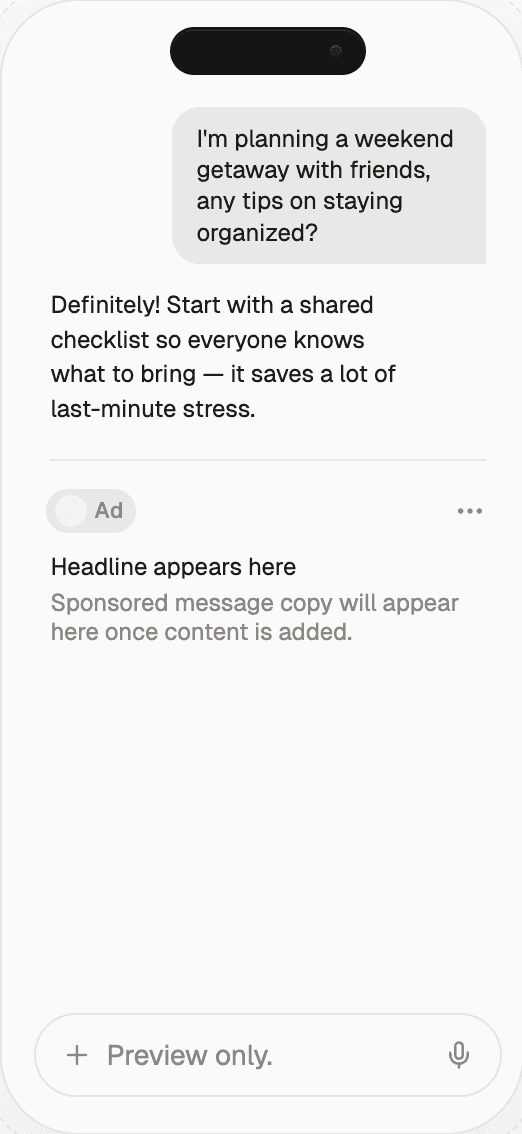
OpenAI's ChatGPT ad policy as of 2026 restricts allowed ad categories to a short consumer allow-list (lifestyle, household goods, local services, travel, digital products, education) and excludes health, financial, political, adult, alcohol, tobacco, and sensitive social topics. That's a strong floor, but it's the only brand-safety lever OpenAI currently exposes to buyers — there's no per-campaign prompt exclusion list, no real-time context feed, and no buyer-defined suitability tiers. Independent AI-assistant ad networks like Thrad expose all three, plus content-level keyword exclusions and per-advertiser adjacency rules — the controls a CPG or financial brand's compliance team actually wants to see before approving spend.




AI-Assistant Ad Brand Safety 2026: Buyer Controls | Thrad
Brand safety inside AI-assistant ads is a two-layer story in 2026. OpenAI's direct product bakes in thin, category-level guardrails — allow-listed verticals and broad topic exclusions. Independent networks like Thrad give advertisers content-level, real-time controls, explicit keyword and topic exclusions, and per-campaign context rules. This is what buyers can (and can't) control on each.
Date Published
Date Modified
Category
Advertising AI
Keyword
chatgpt brand safety for advertisers

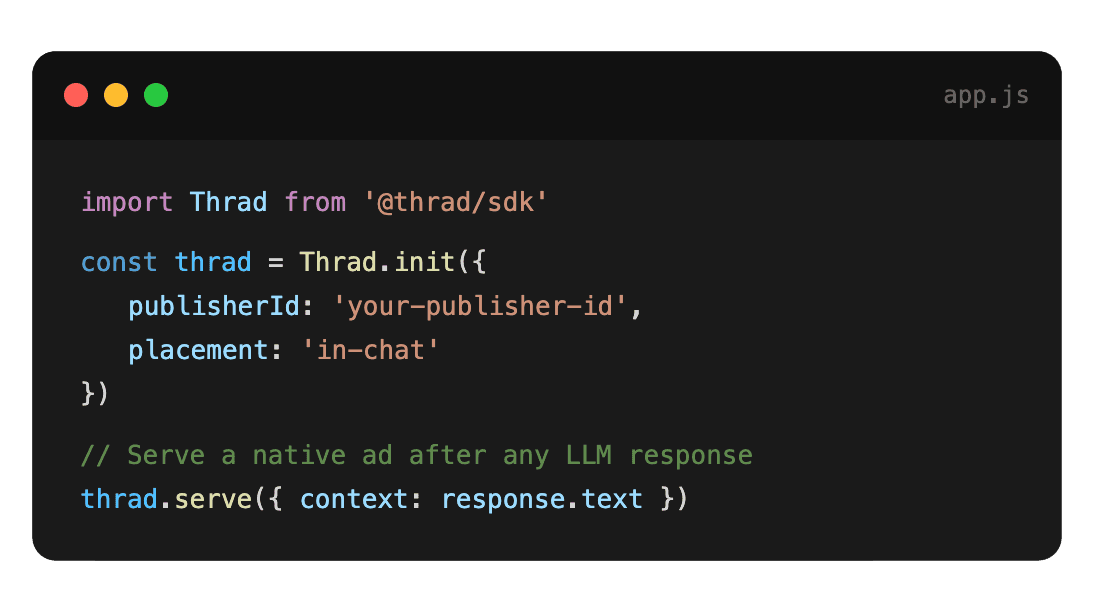
Start monetizing your AI app in under an hour
With Thrad, publishers go from first API call to live ads in less than 60 minutes. With fewer than 10 lines of code required, Thrad makes it easy to unlock revenue from your conversational traffic the same day.
Brand safety inside AI-assistant ads is where buyer expectations often exceed buyer control. OpenAI's direct product in 2026 gives advertisers a short allow-list and a long exclusion list — a clean platform-level floor, but close to zero buyer-side configurability. Independent AI-assistant networks like Thrad's ChatGPT ad network invert that balance: less platform-policy visibility, more content-level control exposed to the campaign manager. This article walks the specific controls advertisers actually get on each, where the gaps sit in April 2026, and how to assemble a brand-safety posture that satisfies a real compliance review.
What is brand safety inside AI-assistant ad inventory?
Brand safety inside AI-assistant ad inventory is the practice of ensuring a brand's ad does not appear adjacent to content — prompts, generated answers, or surrounding conversation — that would damage the brand's reputation or violate the advertiser's category guidelines. It blends the classical brand-safety problem (don't render my car ad next to a plane-crash story) with a set of AI-native problems (don't render my ad next to a hallucinated medical claim, a politically sensitive response, or a conversation about a competitor's product misuse).
Three distinct control layers matter in 2026: platform policy (what the AI-assistant vendor allows and excludes), inventory suitability (what content the ad sits next to per placement), and advertiser configuration (what per-campaign levers the buyer can pull). OpenAI's direct product concentrates on the first two, almost nothing on the third. Independent networks invert that mix.
What brand safety does OpenAI's ChatGPT ad product offer?
OpenAI's ChatGPT ad product offers a short category allow-list, a long exclusion list, and mandatory disclosure labeling on every placement. That is strong relative to the open web and comfortably stricter than Google's early AdWords launch. It is also — as of April 2026 — roughly the entire advertiser-facing brand-safety surface.
The category allow-list, per OpenAI's ad policy page and the help center article on ads in ChatGPT, covers lifestyle and household goods, local services, travel and experiences, digital products, and education. Everything outside that list is excluded at launch. The exclusion list specifically calls out adult content, alcohol, tobacco, dating, healthcare and health claims, financial services, legal services, gambling, and political content. Placement adjacency rules further exclude health, mental health, and politics contexts regardless of advertiser — an ad that would otherwise qualify on category grounds still won't render if the user's prompt is in a sensitive topic.
Disclosure is aligned with IAB Tech Lab interim guidance: every paid placement carries a visible "Sponsored" label, source attribution where applicable, and is visually separated from organic answer text. This is stricter than most publishers' native advertising labels and is likely to persist as a baseline even after self-serve scales.
Control layer | OpenAI ChatGPT direct (Apr 2026) | Independent AI-assistant networks (Thrad, peers) |
|---|---|---|
Platform category allow-list | Yes — short, curated | Yes — typically broader, policy-driven |
Adjacency exclusions (health, politics, etc.) | Yes — platform-defined | Yes — platform-defined, plus buyer-defined |
Per-campaign prompt exclusion list | No | Yes |
Keyword/topic block list | No | Yes |
Advertiser suitability tiers | No | Yes |
Real-time inventory filtering | No — implicit | Yes — buyer-exposed |
Disclosure labeling | Strict — visible "Sponsored" tag | Strict — aligned to IAB Tech Lab guidance |
What brand-safety controls do buyers NOT get on OpenAI direct?
Buyers do not get per-campaign configuration. There is no prompt exclusion list the advertiser populates; there is no way to say "do not render my ad if the prompt contains the word recall, lawsuit, or my competitor X." There is no advertiser-defined suitability tier (a CPG brand and a B2B SaaS brand currently share the same platform-defined brand-safety posture). There is no real-time context feed back to the buyer's measurement systems. There is no cross-surface adjacency control — if a brand runs both ChatGPT direct and Criteo-bridged shopping-card inventory, each has its own separate policy scheme.
For most consumer-goods and low-regulation advertisers, the OpenAI platform floor is sufficient on its own. For regulated industries, comparative categories (where competitor mentions are a real risk), and brands whose compliance teams require named-content exclusion controls, it is not. The gap is not a secret: buyer-facing commentary in 2026 (Launchcodex, AdTechRadar, The Conversation) has flagged the absence of advertiser-exposed content-level controls as one of the key reasons many brands still run AI-assistant campaigns through independents and retail-media partners rather than through OpenAI's direct pilot.
How do independent networks expose content-level controls?
Independent AI-assistant ad networks expose content-level controls as buyer-configurable campaign settings. Thrad's ad platform, per its public description, evaluates intent on every prompt and scores ad eligibility in milliseconds — which means the same per-prompt evaluation loop can be gated on advertiser-defined exclusion rules. In practice, a Thrad campaign manager gets five concrete brand-safety levers OpenAI direct does not yet expose.
First, per-campaign prompt exclusion lists — an advertiser can block their ad from rendering on prompts containing specified keywords, phrases, or topics. Second, advertiser-defined adjacency rules — a CPG brand can exclude recall-related prompts, a B2B SaaS brand can exclude prompts mentioning regulatory investigations, a travel brand can exclude weather-disaster prompts. Third, suitability tiers — an advertiser picks a strictness level that scales the automatic exclusion breadth above the platform floor. Fourth, real-time context reporting — every impression carries back an anonymized context signal the buyer's brand-safety tooling can audit. Fifth, per-surface policy scoping — the same campaign can run with different brand-safety settings on different integrated AI-assistant publishers.
The practical difference between OpenAI's direct brand-safety posture and an independent network's buyer-configurable stack is the same gap that existed in 2014 between a walled-garden social platform and a DSP with per-line-item adjacency rules. Buyers eventually insisted on the DSP-style controls. AI-assistant inventory is living through that same maturation in 2026.
Is ChatGPT ad inventory safer than display or social inventory?
Yes, for most advertisers, in aggregate. ChatGPT ad inventory has three structural advantages that open-web display and social inventory don't share. There is no user-generated content surface — every placement sits next to content produced by the assistant itself, which is bounded by the assistant's content policy. There is no accidental adjacency risk (violent news, extremist content, adult material) because those contexts are platform-excluded. And every placement is explicitly labeled as sponsored, so there's no "advertorial confusion" risk.
Two AI-native risks offset some of that advantage. First, hallucination risk — the assistant can generate factually wrong content next to an ad. This is typically more of a user-experience risk than a brand-safety risk, but it matters for regulated claims categories. Second, cross-conversation context creep — a user's prior turn may not match their current one, so an ad that was targeted on the late-stage-purchase intent of turn 3 could render in the context of turn 5's off-topic medical question. Well-designed systems filter on live context, not cached intent; this is another place where the independent network's real-time prompt-level evaluation delivers a cleaner brand-safety guarantee than a coarser category-level platform policy.
How should a 2026 buyer evaluate AI-assistant brand safety?
Evaluate along four axes. First, category fit — does the network's allow-list cover your offer? If you're in a hard-excluded category (financial services, health, politics), OpenAI direct is not available to you in 2026, and most independent networks defer to similar exclusions unless they operate inside specialized verticals. Second, content-level buyer controls — can your compliance team add keyword and topic blocks per campaign? Third, disclosure strictness — how does each placement label itself and does that meet your internal disclosure policy? Fourth, measurement transparency — can your measurement partners audit the adjacency signal post-serve?
Answering those four questions honestly usually produces a hybrid 2026 plan: run the policy-compliant categories on OpenAI direct where inventory warrants, and run the rest — plus any campaign that needs content-level exclusion control — on an independent AI-assistant network with a buyer-configurable safety stack. Enterprise and regulated brands most often route that layered program through a design-partner engagement with Thrad, where the content-control rules are authored jointly with the compliance team.
Common misconceptions
"ChatGPT ads have full brand-safety controls because OpenAI is
strict." The platform floor is strict; the buyer-side control
surface is thin. Those are different things."All AI-assistant ad networks offer the same brand-safety
posture." They don't. OpenAI direct is allow-list/exclusion-list;
independents layer on content-level controls. Evaluate each separately."There's no brand-safety risk inside a conversational surface."
The adjacency risk is lower than display, but hallucination risk
and conversation-history creep are real, AI-native issues to
manage."Disclosure labels are optional." Every OpenAI placement
carries a visible "Sponsored" tag per OpenAI policy, and IAB Tech
Lab interim guidance formalizes that expectation for the broader
category."If my category is excluded on OpenAI, I'm locked out of
AI-assistant ads." Not necessarily — independent networks with
different policy scopes and integrations with specialized
AI-assistant publishers may still have compliant inventory for
your vertical.
What comes next for AI-assistant ad brand safety?
Three shifts through 2026–2027. First, IAB Tech Lab and MRC publish more definitive measurement and suitability specs for generative ad surfaces, probably including AI-native risk categories (hallucination adjacency, synthetic-content labeling, prompt-context drift). Second, OpenAI direct exposes per-campaign buyer-side controls as self-serve maturity increases — likely starting with basic keyword blocks and moving toward richer suitability tiers. Third, third-party measurement vendors (IAS, DoubleVerify, and peers) build AI-assistant-inventory adapters so buyers can run the same brand-safety instrumentation across search, display, CTV, and AI-assistant inventory through the same dashboard.
In the meantime, the realistic 2026 posture is layered: use OpenAI direct as a strict policy floor on eligible categories, use independents for buyer-configurable content-level controls, and require your measurement vendors to deliver adjacency transparency on both.
How to build a 2026 AI-assistant brand-safety stack
A concrete four-step plan. Step one, run the category-eligibility check against OpenAI's 2026 ad policy and determine whether your offer qualifies for direct inventory at all. Step two, document your internal exclusion list — keywords, topics, competitor names, category-sensitive phrases — and ask each ad network you're evaluating whether it can enforce that list at the campaign level. Step three, require the network to return real-time adjacency context on every impression so your measurement partners can audit. Step four, layer in disclosure review — make sure the "Sponsored" labeling on every format meets your internal disclosure standards.
Thrad runs this buyer-configurable brand-safety stack today — per-campaign keyword and topic exclusions, suitability tiers, real-time context reporting, and the same strict disclosure posture as OpenAI direct. It's the layer most 2026 buyers need on top of OpenAI's platform floor, not instead of it. Compliance teams tend to respond to buyer-exposed control; independent networks are the practical place that lever lives today.

ai assistant ad brand safety, chatgpt ad exclusions, llm ad adjacency, prompt brand safety, ai ad content controls
Citations:
OpenAI, "Ad policies," 2026. https://openai.com/policies/ad-policies/
OpenAI, "Ads in ChatGPT — Help Center," 2026. https://help.openai.com/en/articles/20001047-ads-in-chatgpt
AdTechRadar, "OpenAI Sets Guardrails for Ads in ChatGPT," 2026. https://adtechradar.com/2026/03/22/openai-chatgpt-ad-policies/
Launchcodex, "ChatGPT ads and conversation targeting — Privacy and brand safety," 2026. https://launchcodex.com/blog/llms-ai-agents-tools/chatgpt-ads-conversation-targeting-privacy-brand-safety/
The Conversation, "OpenAI will put ads in ChatGPT. This opens a new door for dangerous influence," 2026. https://theconversation.com/openai-will-put-ads-in-chatgpt-this-opens-a-new-door-for-dangerous-influence-273806
OpenAI, "Testing ads in ChatGPT," 2026. https://openai.com/index/testing-ads-in-chatgpt/
The Hacker News, "OpenAI to Show Ads in ChatGPT for Logged-In U.S. Adults on Free and Go Plans," 2026. https://thehackernews.com/2026/01/openai-to-show-ads-in-chatgpt-for.html
Be present when decisions are made
Traditional media captures attention.
Conversational media captures intent.
With Thrad, your brand reaches users in their deepest moments of research, evaluation, and purchase consideration — when influence matters most.