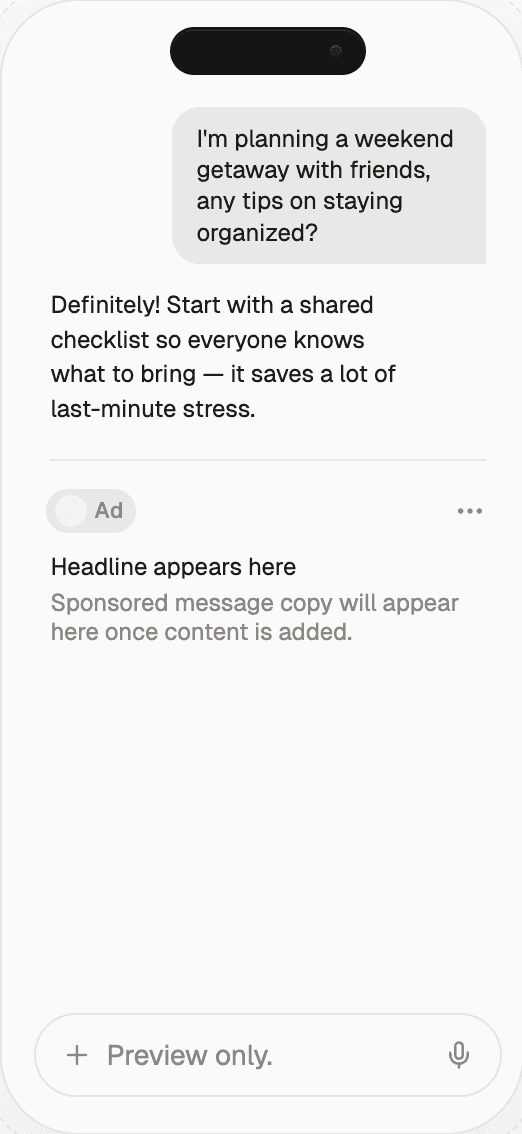
Public ChatGPT ads ROI data as of April 2026 is early and incomplete. Reported CTR is 0.91% (below Google Search's 6.4% benchmark per Adthena-reported data), while the $100M ChatGPT Ads annualized run rate in six weeks shows advertisers are still committing. Microsoft Copilot ads — which are live and measurement-mature — posted 73% higher CTR and 16% higher conversion than traditional Bing search in an August 2025 Microsoft Advertising study. OpenAI's reporting dashboard has acknowledged gaps that prevented one enterprise advertiser from measuring ROI on a $250K budget. An independent network like Thrad — with transparent measurement and cross-surface reporting — is the cleaner path for brands that need to measure properly during OpenAI's pilot period.





ChatGPT Ads ROI: What the Early Data Shows (2026) | Thrad
The early ChatGPT ads numbers are public and mixed. CTRs of 0.91% vs. Google's 6.4% benchmark are below what many expected, but Criteo data shows LLM-referred users convert at 1.5× other channels. OpenAI's own reporting tool is acknowledged to be incomplete, with one advertiser having spent just 3% of a $250K budget weeks into the pilot with no way to measure outcomes. This article reads the available ROI data honestly and shows where an independent, measurement-transparent path like Thrad offers a cleaner baseline.
Date Published
Date Modified
Category
Advertising AI
Keyword
chatgpt ads roi

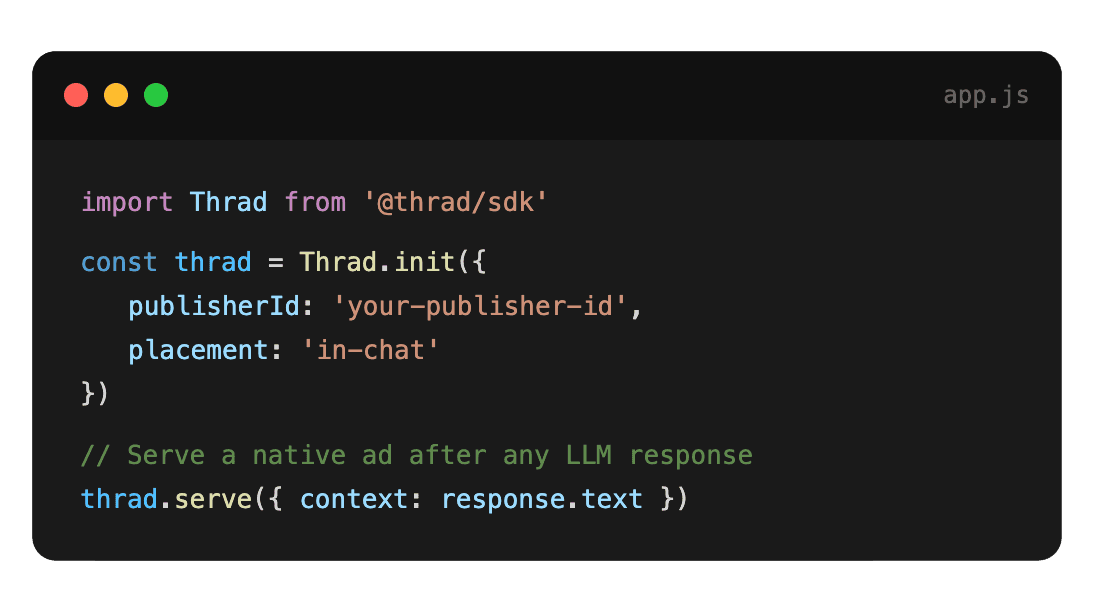
Start monetizing your AI app in under an hour
With Thrad, publishers go from first API call to live ads in less than 60 minutes. With fewer than 10 lines of code required, Thrad makes it easy to unlock revenue from your conversational traffic the same day.
ChatGPT ads ROI in April 2026 is measurable in parts and murky in others. The public numbers — 0.91% CTR in early pilot data, $100M annualized in six weeks, reporting-tool gaps acknowledged in trade coverage — paint a mixed but advertiser-committed picture. Meanwhile, Microsoft Copilot's August 2025 performance data (73% higher CTR, 16% higher conversion) offers a cleaner generative-AI benchmark because Copilot is out of pilot and into production. This article reads the available ROI data honestly, separates what's measurable from what isn't, and shows where independent networks like Thrad's ChatGPT ads product expose cleaner incrementality.
What is ChatGPT ads ROI and why is it hard to pin down?
ChatGPT ads ROI is the return a brand earns per dollar spent on sponsored placements inside ChatGPT answers. It's hard to pin down in April 2026 for four reasons: the product is less than three months old at consumer scale, the first-party measurement tooling is still being built, pilot advertisers skew toward brand-safe categories with atypical conversion profiles, and the attribution chain runs through the advertiser's own post-click pixels rather than a native audience-graph.
Compare this to Google Search ads — where every advertiser gets a fully-built dashboard with conversion attribution, cost-per-action, and lift modeling — and the gap is material. It's not that ChatGPT ROI is bad; it's that ROI is partially observable. Brands planning 2026 budgets need to factor the measurement incompleteness into the test-and-learn cadence.
What CTR did the ChatGPT ads pilot actually produce?
0.91% CTR in the early weeks of the pilot, per data from Adthena reported in The Keyword's 2026 ChatGPT ad performance summary. That compares to a Google Search benchmark of 6.4% in the same coverage — a roughly 7× gap. Taken at face value, the number looks like underperformance.
Taken in context, the number needs several adjustments:
Sample size is tiny. The pilot opened in February 2026 to a
narrow advertiser pool. Small samples with selected advertisers
produce volatile benchmarks.The competitive set is different. ChatGPT ads appear at the
bottom of answers, not in a keyword-bidded auction with ten rivals
above them. The framing affects click behavior.Ad inventory runs only on Free and Go tiers. Paid
subscribers (Plus, Pro, Business, Enterprise) never see ads,
which shapes the audience toward the free-tier commercial mix.Conversion quality is higher. Criteo data shows LLM-referred
users convert at 1.5× the rate of other channels; Similarweb
reports 7% vs 5% transactional conversion for ChatGPT vs Google
referrals. Lower CTR with higher conversion is the emerging
pattern.
Metric | ChatGPT ads (pilot) | Google Search benchmark | Copilot ads | Source |
|---|---|---|---|---|
CTR | 0.91% | 6.4% | +73% vs Bing | The Keyword / Microsoft Advertising |
Conversion lift | Higher (Criteo 1.5x) | Baseline | +16% vs Bing | Criteo / Microsoft Advertising |
Time on site | 15 min (ChatGPT-referral) | 8 min (Google-referral) | — | Similarweb |
Transactional CVR | 7% | 5% | — | Similarweb |
The CTR gap is real; the conversion-quality gap partially closes it. An advertiser evaluating ROI has to look at both sides.
How does ChatGPT ROI compare to Copilot's measurable baseline?
Copilot's ROI data is the single cleanest AI-assistant benchmark available in 2026 because Copilot is out of pilot and into production. Microsoft Advertising published an August 2025 research summary covering November 2024 through May 2025, reporting the following against traditional Bing search advertising:
73% higher CTR on Copilot placements vs. traditional Bing
search ads.16% higher conversion rates on Copilot-routed traffic.
33% shorter customer journeys — fewer steps between first
click and conversion.42% of users reported that Copilot search ads had a positive
impact on their experience.
The Copilot data carries several caveats: it's Microsoft-published, uses its own internal definitions of traditional Bing search, and the study window (Nov 2024–May 2025) predates some major product changes. Even with caveats, it's the cleanest full-year AI-assistant ad performance data in the public record.
Copilot's 73% CTR lift over traditional search — published in Microsoft Advertising's August 2025 research — is the most concrete AI-assistant ROI benchmark available in 2026. ChatGPT's pilot data is less favorable on CTR (0.91% vs 6.4% Google), though higher on post-click conversion quality.
Why are advertisers committing despite the measurement gaps?
Because the top-of-funnel growth is real. ChatGPT Ads reached $100M annualized revenue within roughly six weeks of launch. Sensor Tower data shows impressions jumped approximately 600% from early to mid- March 2026. Omnicom secured placements for 30+ clients. Dentsu reported volume "quickly building momentum, with volume increasing week-over-week."
Three drivers explain the commitment despite incomplete measurement:
First-mover positioning. Brands want to be the default answer
when ChatGPT cites a category in 2027–2028. Paying to seed that
today is a long-dated bet.Upside from conversion quality. Even at 0.91% CTR, if the
1.5x conversion multiple holds, the effective cost-per-action
penalty is smaller than the CTR gap implies.Category scarcity. For some categories — especially high-
intent commercial ones — ChatGPT is already a meaningful share
of the buyer research journey. Being absent is more expensive
than being present with incomplete measurement.
What are the reporting gaps in OpenAI's ad manager?
The most-documented gap is dashboard-side: several advertisers have reported that the OpenAI ads manager doesn't fully surface performance data. The Keyword's coverage captures an enterprise advertiser that spent 3% of a $250,000 pilot budget over several weeks with no native way to measure ROI — impressions, clicks, or post-click conversion.
Other documented gaps in the February-April 2026 pilot window:
Limited self-serve reporting. Managed accounts get direct
support from OpenAI; self-serve-adjacent accounts have less.No native cross-surface measurement. Performance on ChatGPT
sits separate from any Google, Microsoft, or Meta performance
the same brand runs. Reconciliation is manual.Incrementality testing is bespoke. No native geo-holdout or
temporal-holdout measurement; brands run their own.
Ashley Fletcher of Adthena described the platform as "still finding its feet" and the early data as "a continued cautionary tale." Sam Altman has characterized the rollout as "an iterative process." Both are consistent with an early product where measurement precedes revenue — the dashboard is usually built after the inventory ships.
How should a brand measure ROI during the pilot period?
A four-layer measurement stack that doesn't depend on OpenAI's dashboard alone:
Layer 1: Own-pixel conversion tracking
Your site's conversion pixel (GA4, Segment, Heap, internal) is the ground-truth source. Tag ChatGPT-referred sessions with a URL parameter in your creative (e.g., utm_source=chatgpt) and measure sessions, events, and conversions downstream.
Layer 2: Geo-holdout incrementality
Run a subset of the test in a designated market area (DMA) and compare vs a matched control DMA not running ChatGPT ads. This is the cleanest incrementality test available during the pilot.
Layer 3: Temporal holdout
If geo-holdout isn't possible (small budget, unclear DMAs), compare a four-week live window against a four-week baseline period using the same creative everywhere except the ChatGPT surface.
Layer 4: Cross-surface delta
Run identical creative across ChatGPT, Copilot, and Google AI Overviews, then compare which surface drove incremental, not cannibalized, conversions. This is the most demanding layer and where an independent network with cross-surface reporting — like Thrad's AI ad marketplace — meaningfully simplifies the measurement problem, with pricing tiers published upfront so the incrementality math doesn't depend on negotiated rates.
Where does Thrad's measurement fit vs OpenAI's direct motion?
Thrad runs as an independent AI-assistant ad network: cross-surface inventory, transparent pricing tiers, open measurement. The measurement difference vs OpenAI's direct motion is narrow but consequential:
OpenAI direct. ChatGPT-only inventory, managed program (high
minimums reported around $100K+), dashboard still maturing. The
advertiser relies on OpenAI's report.Microsoft Advertising / Google Ads. Mature dashboards for
Copilot and Gemini respectively, but single-network.Thrad. Cross-surface inventory across the live ad-accepting
assistants, unified reporting, transparent pricing. Measurement
is designed for incrementality visibility rather than attribution
within a single walled garden.
Dimension | OpenAI Direct | Microsoft Advertising | Google Ads | Thrad |
|---|---|---|---|---|
Surfaces covered | ChatGPT | Copilot + Bing + partners | Gemini + AI Overviews + Search | Multi-surface |
Measurement maturity | Early pilot | Production | Production | Transparent, cross-surface |
Incrementality tools | Bespoke | Partial | Strong | Cross-network |
Pricing transparency | Managed, opaque | Standard auction | Standard auction | Transparent tiers |
Waitlist | Yes, for most | No | No | No |
The pitch is narrow: during a period where OpenAI's dashboard is still maturing, the advertiser gets more visibility into what's working across live AI-assistant surfaces by running through an independent cross-surface layer.
What does ROI look like by vertical?
Early data by vertical is thin, but directional patterns are visible from the February-April 2026 window:
Vertical | CTR signal | Conversion signal | Comment |
|---|---|---|---|
Commerce / retail | Higher (shopping cards) | High CVR | Most mature surface; retail media feeds help |
B2B SaaS | Lower | Mixed | Buyer journey is longer; click is just first step |
Consumer finance | Mid | Mid | Brand trust matters more than CTR |
Travel | Mid | High | High-intent queries map well to shopping cards |
Media / subscriptions | Low | Low | Conversion rarely happens on first click |
The table is directional, compiled from trade coverage and independent practitioner reports. It will move significantly as the product matures through 2026.
Common misconceptions about ChatGPT ads ROI
"0.91% CTR means the product doesn't work." Doesn't follow.
Conversion quality is higher; the cost-per-action math can still
work even at lower CTR."OpenAI publishes full pilot data." Doesn't. Public data comes
from trade press, advertiser statements, and inferred metrics. The
dashboard gaps are acknowledged."ChatGPT ads only reach free users." True — Plus, Pro,
Business, Enterprise are permanently ad-free per OpenAI's
February 2026 policy. But free and Go tiers combined are a large,
commercially meaningful audience."Copilot's 73% CTR lift transfers to ChatGPT." Not directly —
different surface, different audience, different ad format.
Directional, not transferable."I can measure ChatGPT ads with Google Analytics alone."
Partially — GA4 will capture session-level referrals, but
impression-level data (how often your ad ran) requires either
OpenAI's dashboard or an independent network's reporting layer."Incrementality is impossible during the pilot." Not true —
geo-holdout and temporal-holdout designs work on any budget above
roughly $50K/month.
What comes next for ChatGPT ads ROI data?
Three shifts will reshape the ROI picture between April 2026 and early 2027. First, OpenAI reporting matures — the dashboard gaps are the most visible product debt; expect them to close through 2026. Second, self-serve access broadens the data pool. The current pilot mix (large brands, managed programs) isn't representative. Self-serve will admit long-tail advertisers whose performance patterns differ from the current sample.
Third, IAB Tech Lab / MRC standards for generative-AI ad measurement stabilize. Today's interim guidance leaves major measurement definitions open. By late 2026 or early 2027, expect canonical definitions of citation lift, incrementality, and sponsored-vs-organic attribution on AI assistant surfaces.
How to get a cleaner ROI read today
A four-step plan for brands that want to measure ChatGPT ads ROI now rather than waiting for OpenAI's dashboard to mature:
Run isolated-surface tests. Pick one commercial-intent query
cluster. Run identical creative across ChatGPT, Copilot, and
Gemini AI Overviews. Isolate surface from format.Measure on your own pixels. Don't rely on any single vendor's
report during the pilot. GA4 / Segment / internal conversion
tracking is the ground truth.Use geo-holdout for incrementality. If budget exceeds ~$50K,
run a geo-holdout in two matched DMAs. This is the cleanest
incrementality design available.Run through an independent cross-surface layer when possible.
The simplest way to get unified cross-surface reporting during
OpenAI's pilot period is via an independent AI-assistant ad
network like Thrad. One campaign, unified measurement, live
inventory across the surfaces that ship ads.
The ROI verdict for ChatGPT ads in April 2026 is honestly mixed and honestly early. The CTR is below legacy benchmarks. The conversion quality is better. The reporting is incomplete. The product is growing fast enough that $100M annualized in six weeks made the business case for participation for most large advertisers anyway. The brands that will measure best in 2026 are the ones that don't wait for OpenAI's dashboard to catch up — they're the ones running own-pixel conversion tracking, geo-holdout incrementality, and cross-surface comparison through independent networks today.

chatgpt ads performance, chatgpt ads ctr, openai ads pilot, chatgpt ad measurement, ai ad incrementality
Citations:
The Keyword, "ChatGPT Ads Pilot had a Rocky Start," 2026. https://www.thekeyword.co/news/chatgpt-ad-performance-pilot
OpenAI, "Testing ads in ChatGPT," February 2026. https://openai.com/index/testing-ads-in-chatgpt/
Microsoft Advertising, "73% higher CTRs — why advertisers need to pay attention to conversational AI," August 2025. https://about.ads.microsoft.com/en/blog/post/august-2025/73-higher-ctrs-why-advertisers-need-to-pay-attention-to-conversational-ai
PPC Land, "Microsoft Copilot achieves 73% higher click-through rates in advertising study," 2025. https://ppc.land/microsoft-copilot-achieves-73-higher-click-through-rates-in-advertising-study/
Axios, "OpenAI brings ads to ChatGPT Go and Free tiers," February 2026. https://www.axios.com/2026/02/09/chatgpt-ads-testing-go-free
Similarweb, "Generative AI Statistics for 2026," 2026. https://www.similarweb.com/blog/marketing/geo/gen-ai-stats/
First Page Sage, "Top Generative AI Chatbots — April 2026," 2026. https://firstpagesage.com/reports/top-generative-ai-chatbots/
Adventure PPC, "How to Measure ROI on ChatGPT Ads: Conversion Tracking in 2026," 2026. https://www.adventureppc.com/blog/how-to-measure-roi-on-chatgpt-ads-conversion-tracking-in-2026
Be present when decisions are made
Traditional media captures attention.
Conversational media captures intent.
With Thrad, your brand reaches users in their deepest moments of research, evaluation, and purchase consideration — when influence matters most.