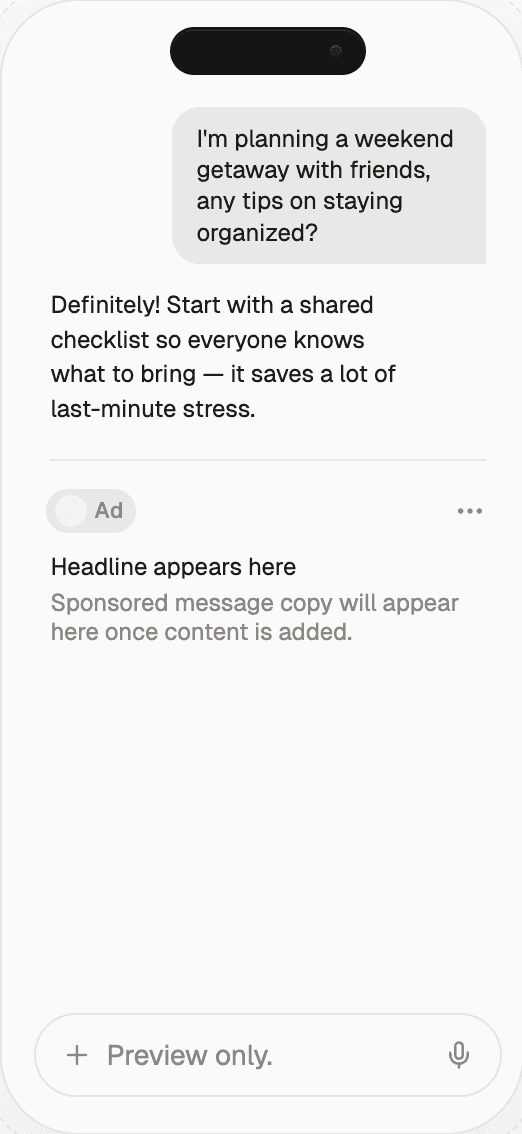
ChatGPT's 2026 revenue comes from seven distinct streams: ChatGPT Plus, ChatGPT Pro, ChatGPT Team, ChatGPT Enterprise, the OpenAI API, advertising and paid search placements, and content-licensing deals. Subscriptions still dominate, but ads and licensing are the fastest-growing lines and are reshaping the mix, pushing total annualized revenue past $12B by Q1 2026.





ChatGPT Revenue Streams Breakdown — 2026 | Thrad
OpenAI's public disclosures and press reporting in 2026 give us enough detail to reconstruct ChatGPT's revenue line-by-line. There are seven distinct streams — not four, as the summary version often suggests — and each one has its own growth rate, margin profile, and strategic role. This is the full breakdown.
Date Published
Date Modified
Category
Advertising AI
Keyword
chatgpt revenue streams
Start monetizing your AI app in under an hour
With Thrad, publishers go from first API call to live ads in less than 60 minutes. With fewer than 10 lines of code required, Thrad makes it easy to unlock revenue from your conversational traffic the same day.
There are seven revenue streams inside ChatGPT in 2026, not the four most summaries list. Each one has its own growth rate, margin profile, audience, and strategic role — and if you only look at the top-line, you miss where the actual changes are happening. The 2026 picture is sharper than any previous year because OpenAI's private-company disclosures, board updates leaked to The Information, and third-party estimates from Stratechery and SemiAnalysis now converge on a consistent shape: roughly $12B annualized at Q1 2026, split across seven lines that behave like seven different businesses.
This breakdown is deliberately structural. It is not a narrative answer to "how does ChatGPT make money" — that is the funnel view. This is the teardown view: one section per revenue line, covering price, volume, growth rate, margin, and strategic role. If you need the narrative, read the how-does-chatgpt-make-money piece. If you need the line-by-line accounting, this is it.
What are ChatGPT's seven revenue streams?
ChatGPT's 2026 revenue splits across seven distinct lines: ChatGPT Plus ($20/mo individual), ChatGPT Pro ($200/mo power user), ChatGPT Team ($25–30/seat for small organizations), ChatGPT Enterprise ($50+/seat negotiated), the OpenAI API (per-token developer access), advertising and paid search placements, and content-licensing deals with publishers. Together they produced roughly $12B in annualized revenue at Q1 2026 according to The Information's reporting, up from approximately $4B in Q1 2024.
The conventional "four streams" framing — subs, API, enterprise, ads — hides three important structural distinctions. Plus and Pro have wildly different per-seat economics and should not be collapsed. Team and Enterprise sell to different buyer personas and carry different gross margins. And licensing, while small, behaves so differently quarter-to- quarter that analysts who blend it into "ads" consistently misread OpenAI's growth curve. Seven lines are the honest decomposition.
Stream 1: How much does ChatGPT Plus contribute?
ChatGPT Plus is the volume line. At $20 per month for individual users and an estimated 15–17 million paying subscribers globally at the end of Q1 2026, Plus contributes somewhere between $3.6B and $4B of annualized revenue — roughly 30–35% of total. Gross margin runs 60–75%, dragged by a long tail of power users whose inference costs exceed the flat monthly fee.
Plus unlocks GPT-4o priority access, image generation, custom GPT use, file uploads up to 512MB, and higher message caps versus the free tier. It is the default upgrade path for the ~700 million monthly active users OpenAI claims across the free product. Conversion from free to Plus sits in the 2–3% band, which is low by SaaS standards but extraordinary given the scale of the denominator.
Growth on Plus is decelerating. In 2024 and early 2025 the line doubled each quarter; by Q1 2026 year-over-year growth is closer to 15–20%. Two dynamics explain the slowdown: the US and EU cohorts most willing to pay $20/month for a general-purpose assistant have largely made the decision, and the arrival of Team as a collaboration-first upgrade has started pulling SMB-employed Plus subscribers into organizational plans.
ChatGPT Plus added roughly 8 million net new paying subscribers between Q1 2024 and Q1 2026. The second 8 million will take materially longer than the first — the marginal convert now sits outside North America and Western Europe, in price bands where $20/month is a meaningful share of disposable income.
Stream 2: What is ChatGPT Pro and why does it matter?
ChatGPT Pro is the margin line. At $200 per month, Pro sells to a narrower audience — researchers, developers, legal and financial professionals, and serious hobbyists who need deep-reasoning models, Operator agent capabilities, advanced voice mode with longer sessions, and video generation. Subscriber count is small, estimated at 250k–300k at Q1 2026, but revenue per user is 10× Plus, so the line punches far above its seat weight — roughly $600M–$720M annualized.
Pro's gross margin is the cleanest in the consumer stack. Even heavy Pro users rarely exceed $60–80 of monthly compute cost because most Pro features are rate-limited in ways that cap downside. The result is 80–85% gross margin per subscriber, with churn under 4% monthly because users who reach Pro typically depend on it for billable work.
The strategic role of Pro is not revenue but demand signal. OpenAI uses Pro's adoption curve to calibrate pricing for Enterprise and for API tier upgrades. When Pro crosses 500k subscribers — probably late 2026 — it becomes a bigger line than the entire API business was in 2023.
Stream 3: What is ChatGPT Team and how does it price?
ChatGPT Team sells to organizations of 2–150 seats at $25 per seat per month on annual billing, or $30 per seat on monthly billing. The pitch is a shared workspace, admin console, team-level GPT sharing, SOC 2 Type II coverage, and a contractual no-training-on-your-data guarantee — all self-serve, without procurement friction. At an estimated 1.5 million seats in Q1 2026, Team contributes roughly $450M–$540M annualized.
Team is the fastest-growing seat-based line, with seat count up roughly 3× year-over-year. Gross margin runs 75–85% — higher than Plus because the typical Team user is a knowledge worker whose 30–90 minutes of daily scattered queries cost less to serve than a Plus power user's marathon coding sessions. A Team seat is a near-perfect product from OpenAI's perspective: it charges more, costs less to serve, and churns less than the Plus equivalent.
The most important role Team plays is as a feeder for Enterprise. When a Team workspace crosses 50–100 seats, IT/security typically requires SSO, SCIM, and data residency — a wall Team doesn't cross. That's the conversion trigger, and OpenAI's finance team almost certainly tracks Team-to-Enterprise migration as a leading KPI.
Stream 4: Why is ChatGPT Enterprise the highest-margin line?
ChatGPT Enterprise is the governance line. Pricing is negotiated — list starts at $50 per seat per month but large deals compress below that — with SSO, SCIM provisioning, data residency options, longer context windows (up to 128k tokens), unlimited GPT-4o use, custom data handling, a named account team, and SOC 2 Type II plus industry compliance mapping (HIPAA BAAs, FedRAMP in pilot). Seat counts per account reach tens of thousands at the top of the market; Bloomberg reported more than 3 million Enterprise seats across OpenAI's book at end of 2025.
At an estimated 3.5–4 million Enterprise seats at Q1 2026 and average realized pricing near $42 per seat per month (after volume discounts), Enterprise produces $1.8B–$2.0B of annualized revenue. Gross margin is the highest in the stack — 85–90% — because governance features (SSO, audit logs, admin tooling) cost almost nothing incrementally to serve once built.
Enterprise compounds at roughly 80% year-over-year, faster than any subscription line outside Team. The compounding is the whole point of the seat-based SaaS pattern: 2024 wins sign three-year contracts, 2025 wins expand within existing customers, and 2026 new-logo growth lands on top of the base. Three years of enterprise compounding is how a consumer brand becomes an enterprise vendor.
Stream | Est. 2026 annualized | Growth YoY | Gross margin |
|---|---|---|---|
ChatGPT Plus | $3.6–4.0B | ~15–20% | 60–75% |
ChatGPT Pro | $600–720M | ~90% | 80–85% |
ChatGPT Team | $450–540M | ~200% | 75–85% |
ChatGPT Enterprise | $1.8–2.0B | ~80% | 85–90% |
OpenAI API | $2.8–3.2B | ~60% | 55–75% |
Advertising | $80–150M | >150% QoQ | N/A (early) |
Licensing | $400–600M | deal-driven | 95%+ (upfront) |
Figures are directional, synthesized from The Information, Bloomberg, and Stratechery reporting plus OpenAI's own published price sheets.
Stream 5: How does OpenAI API revenue scale?
The OpenAI API is the platform line. Every call to GPT-4o, GPT-5, o1, o3-mini, embeddings, Whisper, DALL-E, Realtime audio, or vision is metered per million input and output tokens. Pricing varies by model class: GPT-4o sits at $2.50 input / $10 output per million tokens as of Q1 2026, GPT-5 is priced above that, and specialized endpoints have their own schedules. Cached prompts get a ~50% discount; batch calls get further discounts.
API revenue at Q1 2026 runs an estimated $2.8B–$3.2B annualized, the third-largest line behind Plus and Enterprise. But the underlying dynamics are more interesting than the level. Token volume through the API has roughly tripled year-over-year while per-token pricing has fallen ~45% in the same window. Net revenue growth of ~60% is the compression of those two forces.
The API is strategically critical because it funds the AI-native app economy OpenAI wants to exist. Every coding agent (Cursor, Windsurf, Cognition's Devin), every customer-support bot (Intercom Fin, Sierra, Decagon), every AI wrapper built on an OpenAI endpoint is effectively marketing the underlying model to its own users. Margin on the API is the tightest of the paid lines — 55–75% blended — because competitive pressure from Anthropic, Google, and open-weight alternatives keeps prices falling. OpenAI accepts that margin compression as the cost of maintaining platform gravity.
Per-token API prices have fallen roughly 45% since early 2025 while aggregate token volume tripled. That's the signature of a platform maturing: unit prices fall, unit volume explodes, and aggregate revenue grows in between at a rate that looks slow next to the usage chart but fast next to any public SaaS.
Stream 6: How much is ChatGPT making from advertising?
Advertising is the new line and the one changing fastest. In 2026 OpenAI runs clearly-labeled sponsored results inside ChatGPT's search surface for commercial-intent queries — "best running shoes for flat feet," "crm software for a 10-person sales team," "laptop under $1,500." Pricing is auction-based on a per-click or per-view model similar to Google Shopping ads, with inventory deliberately capped at one to three positions per query.
Revenue here is still small — an estimated $80M–$150M annualized at Q1 2026 — but the growth rate is the highest in the mix. Sponsored placements tripled from Q4 2025 to Q1 2026, and OpenAI's product team has signaled plans to open up two adjacent inventory types: sponsored product cards inside shopping-oriented prompts, and affiliate routing on commerce recommendations. Buyers who want to get in early can already test ChatGPT advertising through Thrad, which runs the commercial layer brands actually buy against. By end of 2026, expect advertising to clear $500M annualized. By end of 2027, 5–10% of total revenue is plausible if the current pace holds.
Ads are structurally necessary, not optional. Free-tier inference cost at 700M MAU dwarfs any subscription line; the unit economics of the free tier only close if a second revenue engine covers the compute. Ads are that engine, and the inventory shape — commercial-intent prompts where users are actively evaluating — is high-value precisely because the context is perfect. Thrad's AI ad platform and marketplace is how brands reach that inventory today.
Stream 7: What is the licensing revenue line?
Content-licensing is the lumpy line. OpenAI has signed multi-year deals with News Corp (reported at $250M+ over five years), Axel Springer ($25M+/year), the Financial Times, Associated Press, Condé Nast, Dotdash Meredith, Reuters, Vox Media, and more than a dozen other publishers. Structure is typically upfront payment plus per-use revenue share, with the publisher granting training rights, attribution rights, and retrieval-time access.
Because most of the deal value is booked upfront, this line distorts quarterly growth — a major deal closing can add 5–10% to reported revenue for a single quarter and then drop out the next. At Q1 2026, recognized licensing revenue runs roughly $400M–$600M annualized, but the actual cash receipts swing more violently. Gross margin on recognized licensing revenue is 95%+ because the incremental cost of serving licensed citations inside ChatGPT answers is minimal once the retrieval infrastructure is built.
The strategic purpose of licensing is not revenue — it's defending the training data pipeline and creating a citation surface that advertisers will eventually pay to influence. When ChatGPT cites the FT in an answer, OpenAI pays; when a brand wants to appear adjacent to FT citations on financial-services queries, that becomes advertising inventory. The two lines compound into each other.
Why is the revenue mix shifting in 2026?
Three structural forces are reshaping the mix simultaneously. First, consumer subscription saturation: Plus growth has decelerated from ~3× per year in 2024 to ~1.15–1.2× in 2026, as the cohort willing to pay $20/month for a general-purpose assistant matures. Second, enterprise procurement compounding: seat deals signed in 2024 and 2025 are renewing and expanding, with per-account seat counts up ~2× per renewal. Third, the ads line starting from zero: any new stream starts with a very high growth rate, and ads will move from roughly 1% of revenue at Q1 2026 to 8–12% by end of 2027 on current trajectory.
A fourth, subtler force: API pricing compression driven by Anthropic, Gemini, and open-weight alternatives is pulling API margin down while token volume is growing ~3× year-over-year. Net API revenue still grows, but the composition is volume-driven rather than price-driven, which has second-order effects on how OpenAI invests in the developer stack vs. consumer surfaces.
Force | Impact on mix | 2026–2027 direction |
|---|---|---|
Plus saturation | Plus share shrinks | From ~33% to ~25% of total |
Enterprise compounding | Enterprise share grows | From ~17% to ~25–28% |
API price compression | API share stable in $ | Volume up 3×, price down 45% |
Ads ramping off zero | Ads share growing fast | From <1% to 8–12% |
Licensing lumpiness | Mix distortion per quarter | Smooths as deal base grows |
What do these streams imply for brands?
For brand marketers, only three of the seven streams are directly actionable: advertising (Stream 6), licensing (Stream 7), and — less obviously — API (Stream 5), where your content and data can be cited in AI-native products your customers use. The subscription lines (Plus, Pro, Team, Enterprise) are audience surfaces but not ad inventory in themselves.
Two practical observations about the ad inventory specifically. First, inventory is scarce. Sponsored placements are limited to one to three positions per commercial-intent query, and OpenAI is being deliberately conservative about expanding density. The scarcity is the feature — it's what keeps the format from looking like a search results page. Second, targeting is contextual, not behavioral. Placements trigger on prompt intent, not on user identity or cookies. This is the same direction the rest of the open web is moving post-cookies, and it rewards brands with strong category-level semantic presence.
For licensing, the surface is different. Publisher-style content — guides, reference, reviews, authoritative explainers — is what OpenAI pays for and cites. If your brand publishes that kind of content and can negotiate its own retrieval-time deal, you appear in answers in a way that ad inventory doesn't support.
Common misconceptions about ChatGPT revenue
"It's all subscription." Not anymore — as of 2026 the mix has
five other meaningful lines, and the three non-subscription lines
(API, ads, licensing) together already exceed $3B annualized."API revenue is a side business." It's a top-three line, roughly
the same size as Enterprise, and funding most of the AI-native app
economy. Treating it as peripheral misreads where platform power
actually lives."Enterprise is a marketing story." It's the margin story.
Governance features are what customers actually pay for, and they
cost near zero to serve after the initial build."Ads will cannibalize subscriptions." There's no evidence for
this — ads appear almost exclusively on commercial-intent queries
that Plus subscribers also see with labeling. Sub retention in the
ads-live period has not measurably changed."Licensing is just a PR expense." It's a growing 3–5% revenue
line on a recognized basis, and it underwrites the training data
pipeline and citation surface that advertisers will eventually pay
to influence.
What comes next for the revenue mix?
Watch for four signals through 2026 and into 2027. First, whether advertising crosses 5% of total revenue — that's the threshold beyond which it becomes a board-level strategic priority rather than a product experiment. Second, whether Pro seat count doubles to 500k+, confirming the thesis that high-intensity professional users are willing to pay at laptop-software price points. Third, whether a single licensing deal exceeds $1B in committed value — that would signal publishers have internalized OpenAI as a durable distribution channel rather than a training data pipeline. Fourth, whether Enterprise clears $3B annualized by end of 2026, which on current growth is probable and would reshape the analyst narrative from "consumer AI company" to "enterprise AI company with a consumer surface."
Any of these four unlocks changes the headline framing of OpenAI. All four together, which is plausible, produce a 2027 revenue mix where subscriptions are less than 50% of total for the first time since 2023.
How to act on this breakdown
If you're a brand thinking about where ChatGPT inventory fits in your plan, the best first move is small: pilot presence on a narrow set of commercial-intent prompts in your category, measure how generative answers currently describe your brand, and build from there. Focus on the two streams you can actually buy against — advertising (sponsored placements) and licensing (if you publish in volume). Skip the subscription lines as targets; they're audience surfaces, not ad inventory.
If you're building on the API, the revenue framing matters for a different reason: the fastest-growing cohort of OpenAI's customer base is developers whose products cite brand content. Structuring your own content for clean citation — stable URLs, explicit attribution-friendly markup, citable facts with dates — is how you appear on the API side of the ledger rather than waiting for the ad auction to mature. That measurement and placement layer is exactly what Thrad ships.

chatgpt plus revenue, chatgpt api revenue, chatgpt enterprise revenue, openai revenue breakdown
Citations:
OpenAI, "ChatGPT pricing and plans," 2026. https://openai.com/chatgpt/pricing
The Information, "OpenAI Q1 2026 revenue breakdown," 2026. https://theinformation.com
Bloomberg, "OpenAI enterprise seat growth 2025-2026," 2026. https://bloomberg.com
Axios, "Publisher licensing deals with OpenAI," 2026. https://axios.com
Stratechery, "OpenAI's Seven Revenue Lines," 2026. https://stratechery.com
SemiAnalysis, "Frontier model inference cost curves," 2026. https://semianalysis.com
Be present when decisions are made
Traditional media captures attention.
Conversational media captures intent.
With Thrad, your brand reaches users in their deepest moments of research, evaluation, and purchase consideration — when influence matters most.