AI-assistant ad measurement in 2026 is a three-layer problem. First, platform reporting — OpenAI direct currently exposes impressions and clicks only, with a conversion pixel in closed beta supporting five event types (lead, order, page view, subscription, trial). Second, attribution — ChatGPT sessions collapse research, compare, and decide into one prompt, breaking classical multi-touch models and concentrating the zero-click attribution problem. Third, incrementality — geo-holdout and temporal-holdout remain the only defensible methods for measuring AI-assistant ad lift in a boardroom. Independent networks like Thrad expose server-side attribution, cross-surface reporting, and raw citation-lift signals that OpenAI's direct pilot doesn't yet surface to buyers.







Honest AI-Assistant Ad Measurement 2026 | Thrad
OpenAI's ChatGPT ads reporting is impressions and clicks, with conversion tracking in limited beta as of April 2026. That means most campaigns are flying half-blind on the direct product. This is the 2026 honest framework for AI-assistant ad measurement — the metrics that matter, the zero-click attribution problem, the incrementality methods that survive a finance review, and what independents expose that OpenAI doesn't.
Date Published
Date Modified
Category
Advertising AI
Keyword
chatgpt ads measurement

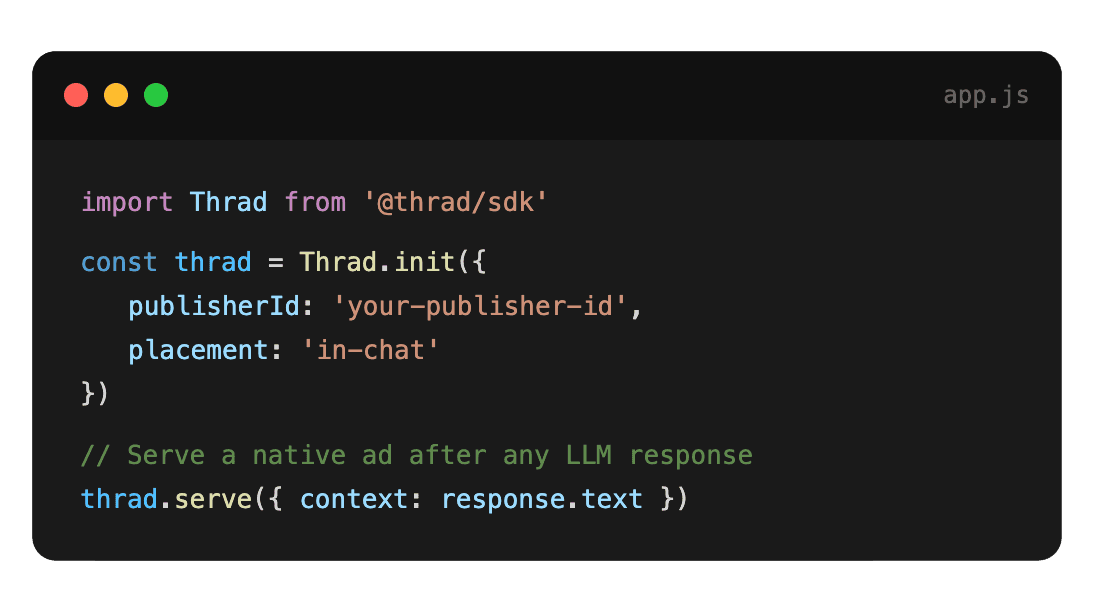
Start monetizing your AI app in under an hour
With Thrad, publishers go from first API call to live ads in less than 60 minutes. With fewer than 10 lines of code required, Thrad makes it easy to unlock revenue from your conversational traffic the same day.
AI-assistant ad measurement in 2026 is the category's honest weak spot. OpenAI's direct ads product currently reports impressions and clicks; the conversion pixel that would unlock standard performance measurement is live for a subset of advertisers and — in the words of the April 2026 Digiday reporting — "selectively enabled for certain advertisers" while it matures. Zero-click attribution, the problem that defines the AI-era measurement landscape, is still unresolved. This article walks the measurement stack advertisers actually need in 2026 — what the platforms report, what the gaps are, which methodologies survive scrutiny, and where independent networks close the gap.
What is AI-assistant ad measurement?
AI-assistant ad measurement is the set of methods and metrics advertisers use to quantify the performance of ads placed inside ChatGPT, Copilot, Perplexity, Gemini, and other AI assistants. It inherits the metric vocabulary of classical digital measurement — impressions, clicks, CTR, CPA, ROAS, incrementality — but the underlying data flow is different in three important ways.
First, a meaningful share of AI-assistant sessions end without a click, because the assistant answers in place. Second, the attribution window compresses — research, evaluation, and decision often happen inside a single conversation, so classical multi-touch path models flatten. Third, the data the ad platform returns is sparser than the data Google or Meta surface — OpenAI's direct product, as of April 2026, returns platform-level impressions and clicks only, with conversion reporting gated to a pixel beta.
What does OpenAI's ChatGPT ads reporting actually expose?
It exposes impressions, clicks, and (for beta-enabled advertisers) five conversion event types through the ChatGPT conversion pixel. The pixel, per Digiday's April 2026 reporting, supports lead created, order created, page viewed, subscription created, and trial started as its current event taxonomy. That closes the loop for pilot advertisers with site-level conversion events but does not expose the richer multi-touch reporting Google Ads and Meta Ads expose today.
The self-serve manager that launched April 13, 2026 currently supports reach-style campaign reporting and does not yet surface cost-per-action or multi-touch path reports, consistent with the platform's CPC/CPA bidding being flagged as "in development." For most 2026 ChatGPT advertisers that means: rely on impressions and clicks for real-time optimization, use the pixel (where available) for bottom-of-funnel confirmation, and solve the rest of the measurement problem off-platform.
Metric / capability | OpenAI ChatGPT direct (Apr 2026) | Independent AI-assistant networks (Thrad, peers) |
|---|---|---|
Impressions, clicks, CTR | Yes | Yes |
Conversion events (5 types) | Yes, beta-gated | Yes, server-side |
CPA reporting by campaign | Not yet | Yes |
Multi-touch path reporting | No | Partial (cross-surface) |
Cross-surface reporting | No (ChatGPT only) | Yes (multi-assistant network) |
Citation lift / assistant influence | No | Yes — raw signal exposed |
Server-side event delivery | Partial (pixel-based) | Yes — native server-side |
Real-time adjacency context | No | Yes |
Why is zero-click attribution the hardest measurement problem?
Because a meaningful share of AI-assistant sessions convert a user without a click. The 2026 state of the measurement literature converges on the "nearly 60% of all searches now end without a click" number as the headline figure for the AI-era zero-click phenomenon — AI-assistant answers in-place and the user doesn't traverse an ad-addressable hop. Under any standard click-last-touch or click-linear attribution, that ad's influence gets credited to "direct" or "organic" traffic, not to the AI-assistant channel.
That's a measurement problem, but it's mostly a budgeting problem. A CMO who allocates budget on attributed ROAS will systematically underfund AI-assistant advertising even when the incremental contribution is real. The 2026 defensible move is to flip the measurement hierarchy — demote attribution reporting to the optimization signal, promote incrementality testing to the budget-defense signal.
The honest read on AI-assistant ad measurement in 2026: the attribution layer will always undercount the channel because of zero-click sessions. Don't try to fix that inside attribution. Fix it by moving the budget-defense conversation to incrementality, where the methodology actually matches the channel mechanics.
What incrementality methods work for AI-assistant ads?
Three methods work, each with different cost and data requirements.
Geo-holdout
Geo-holdout is the gold standard. Pick a matched set of geographies — DMAs, regions, or countries — split them into test and control, run AI-assistant ads in test and suppress them in control, measure the revenue delta. The method survives zero-click sessions because it doesn't care about click paths at all; it cares about aggregate outcome deltas. Requires: enough geographic revenue variance to detect lift, 4–8 weeks of runtime, and basic market-match discipline.
Temporal-holdout
Temporal-holdout pauses AI-assistant advertising for a fixed window, measures the downstream revenue change, then resumes. Cheaper than geo-holdout but noisier — seasonal effects confound temporal tests in most retail and consumer categories. Best used as a confirmation for a geo-holdout finding, not as a standalone method.
Media-mix modeling (MMM)
MMM fits a statistical model of revenue against all marketing channels and isolates AI-assistant contribution. Powerful for advertisers with 18+ months of spend history and clean weekly revenue data by channel. Most helpful after geo-holdout confirms directional lift and the MMM calibrates the magnitude. Most consumer brands won't have enough AI-assistant spend history in 2026 for a clean MMM contribution estimate — 2027 is when this layer becomes tractable for most teams.
What new KPIs matter for AI-assistant ad measurement?
Three new KPIs matter alongside classical CTR and CVR. First, citation lift — how often is the brand mentioned in generative answers before vs after an AI-assistant ad campaign launches? This catches both direct ad influence and the broader visibility halo that comes from being in the consideration set. Second, assistant influence score — a composite metric that estimates the AI-assistant contribution to conversions including zero-click paths, typically calibrated from the brand's geo-holdout tests. Third, zero-click conversions — conversions that happened without a click path originating in the AI-assistant session but that geographically or temporally correlate with the campaign.
Independent networks make these KPIs easier to instrument because they expose raw adjacency and citation data back to the buyer. OpenAI direct, as of April 2026, does not surface these signals in its own reporting, so most buyers measure them on their own warehouse side or through measurement partners that have begun integrating AI-assistant inventory.
How do independent ad networks expose richer reporting?
Three ways. First, server-side conversion event delivery — Thrad's ad platform and peer independents accept conversion events from the advertiser's server rather than only from a browser pixel, making the signal robust to ad-blockers, Safari ITP, and in-app browsers. That means more conversions attributed correctly, on a more stable pipeline. Second, cross-surface reporting — an independent network that integrates with multiple AI assistants returns per-surface reporting so a buyer sees the contribution split across ChatGPT, Perplexity, Copilot, and other integrated surfaces inside one dashboard. Third, raw adjacency and citation signal — per-impression context reporting the buyer's warehouse can join with first-party conversion data, enabling custom attribution logic outside the platform's black box.
For a 2026 buyer who actually wants to run a clean measurement program, that reporting surface is the difference between a finance review that ends in "I can't defend this number" and one that ends in "here's the lift, here's the method, here's the 95% CI." It's the practical reason most early 2026 buyers ran AI-assistant campaigns on independents rather than on OpenAI's direct pilot alone.
Common misconceptions
"ChatGPT ads have no measurement." Not quite — the pixel is
live in beta and impressions/clicks are reported. The gap is
richer performance reporting and multi-touch paths, not a
complete absence of data."If I can't attribute it, it didn't work." That's the wrong
frame for AI-assistant ads. Zero-click sessions make attribution
structurally undercount the channel. Incrementality catches the
lift attribution can't."OpenAI's pixel solves the measurement problem." It solves
the closed-loop problem for click-through conversions. It does
not solve the zero-click or multi-touch problems, and it's still
gated to a subset of beta advertisers."Last-click attribution is fine for AI-assistant ads." It
isn't. Last-click systematically credits the final direct or
organic session and misses the AI-assistant influence on the
consideration set."Independent networks don't have real measurement." The
opposite — independents typically expose server-side attribution
and cross-surface reporting that OpenAI's direct product has not
yet shipped to buyers.
What comes next for AI-assistant ad measurement?
Three shifts through 2026–2027. First, OpenAI's conversion pixel generalizes beyond the current beta and lights up CPA-based reporting on the direct self-serve manager. Second, IAB Tech Lab and MRC publish measurement specs that codify zero-click conversions, citation lift, and assistant influence as measurable units — analogous to the viewability standards published a decade ago. Third, classical measurement vendors (Nielsen, MMM specialists, attribution platforms) ship AI-assistant adapters that pull the channel into existing measurement stacks rather than requiring bespoke instrumentation.
In the meantime, the honest 2026 measurement stack is layered: platform-level reporting for optimization, server-side attribution (via independents or your own stack) for campaign-level CPA, geo-holdout for incremental lift, and new KPIs like citation lift and assistant influence score to translate the channel contribution into language finance teams will sign off on.
How to build a 2026 measurement stack
A five-step practical plan. Step one, instrument server-side conversion events across every AI-assistant campaign so you are never pixel-dependent. Step two, on OpenAI direct, opt into the conversion pixel beta when eligible — it adds optimization signal even if it doesn't solve budget defense. Step three, design a geo-holdout incrementality test from day one, not as an afterthought — 4–8 weeks of clean test runtime beats a year of attribution debate. Step four, instrument the new KPIs — citation lift, assistant influence, zero-click conversions — on your own warehouse side using adjacency and citation signal from independent networks. Step five, review quarterly and report incrementality, not attributed ROAS, as the primary budget-defense metric.
Thrad runs this measurement stack end-to-end today — server-side attribution, cross-surface reporting, per-placement adjacency signal, and a dashboard built around the new AI-assistant KPIs, not around a display-ad-first set of metrics. For most 2026 buyers, measurement is the place where the independent-network advantage is most visible. Attribution will keep getting better on OpenAI direct; in 2026 the honest measurement work still happens closer to the buyer's warehouse and to the networks that expose the raw signal.

ai assistant ad measurement, llm ad attribution, chatgpt incrementality, zero-click attribution, citation lift measurement
Citations:
Digiday, "OpenAI builds tool to track whether ChatGPT ads convert," 2026. https://digiday.com/marketing/openai-builds-tool-to-track-whether-chatgpt-ads-convert/
AdventurePPC, "10 ChatGPT Ads Reporting Metrics Every Advertiser Must Track in 2026," 2026. https://www.adventureppc.com/blog/10-ChatGPT-Ads-Reporting-Metrics-Every-Advertiser-Must-Track-in-2026
Ad Age, "ChatGPT ads show early promise but skepticism remains among ad buyers," 2026. https://adage.com/technology/ai/aa-chatgpt-openai-ads-early-promise-ad-buyers/
Mervyn Chua, "Cracking the Attribution Code — Marketing Measurement in 2026," 2026. https://mervynchua.com/cracking-the-attribution-code-marketing-measurement-in-2026/
AdventurePPC, "ChatGPT Ads Attribution — Tracking the Customer Journey in 2026," 2026. https://www.adventureppc.com/blog/chatgpt-ads-attribution-tracking-the-customer-journey-in-2026
MediaPost, "ChatGPT Ads Need Performance Metrics Before OpenAI Goes Public," 2026. https://www.mediapost.com/publications/article/414390/chatgpt-ads-need-performance-metrics-before-openai.html
PPC Land, "ChatGPT ad CPMs drop to $25 as OpenAI races toward global auction," 2026. https://ppc.land/chatgpt-ad-cpms-drop-to-25-as-openai-races-toward-global-auction/
Be present when decisions are made
Traditional media captures attention.
Conversational media captures intent.
With Thrad, your brand reaches users in their deepest moments of research, evaluation, and purchase consideration — when influence matters most.